
How much sleep does a baby need at each age?
WHO sleep ranges from birth to two years, with changing sleep cycles, nap patterns and tiredness cues to help you understand your baby’s sleep.

If you are wondering how much your baby “should” sleep, the answer is a range rather than one number. WHO’s recommendations leave room for individual differences. A sleep record can help you see a pattern, but no total alone tells you whether your baby is well.
How much sleep at each age?
Count sleep across the whole 24 hours, including naps. A night that feels short may be accompanied by several daytime sleeps.
| Baby’s age | Recommended sleep over 24 hours |
|---|---|
| Birth through 3 months | 14–17 hours |
| 4–11 months | 12–16 hours |
| 1–2 years | 11–14 hours |
These ranges come from WHO’s guidance for children under five, also cited by France’s 1000 First Days website. They are broad references rather than a daily score. Sleep varies between children and between days.
AFPA encourages parents to consider daytime behaviour when assessing sleep. Feeding, growth, alertness and comfort also matter. If a pattern concerns you, a healthcare professional can interpret it with the rest of your baby’s health.
Sleep patterns through the first two years
The table below repeats the same WHO ranges across smaller age groups. The additional detail describes development and French guidance about naps; it does not create narrower WHO recommendations.
| Age | Sleep over 24 hours | Daytime pattern and context |
|---|---|---|
| 0–1 month | 14–17 hours | Several sleep periods across day and night; the day–night rhythm is not yet established |
| 2–3 months | 14–17 hours | Several sleeps; the day–night rhythm develops gradually |
| 4–5 months | 12–16 hours | Nap numbers vary; sleep cycles continue changing |
| Around 6 months | 12–16 hours | Ameli describes about three naps; AFPA describes three or four |
| 7–8 months | 12–16 hours | Follow the naps your baby needs; separation can become more upsetting around eight months |
| 9–11 months | 12–16 hours | The late-afternoon nap usually disappears between 9 and 12 months |
| 12–18 months | 11–14 hours | The morning nap usually disappears between 15 and 18 months |
| 18–24 months | 11–14 hours | Usually an early-afternoon nap; cycles approach 70 minutes around two years in AFPA’s description |
Before six months, the French sources cited here do not give a precise nap count. From six months, the nap descriptions follow Assurance Maladie and AFPA. They are observations about common patterns, not targets.
AFPA describes newborn sleep in periods of roughly three to four hours, separated by waking. It places the gradual beginnings of a day–night rhythm after the first month. Later, the early-afternoon nap may remain until somewhere between two and five years. See baby naps by age for those transitions.
Sleep changes during the first year
A newborn sleeps in several periods spread across day and night. Their sleep cycles are much shorter than an adult’s. AFPA describes alternating active and quiet sleep, in cycles of about 50 minutes during the first two months.
As infancy progresses, longer night-time stretches and more organised daytime sleep may emerge. Development is gradual, and a settled period does not mean all subsequent nights will follow the same pattern.
Some parents notice more waking around four months and describe this as a four-month sleep regression. AFPA describes changing cycles between two and six months, but the sources here do not define a fixed start or duration for that regression. Changes can have several causes.
Around eight months, separation anxiety may coincide with unsettled sleep. Our eight-month sleep guide explains this context without treating it as an inevitable stage.
Sleep cycles and brief waking
Sleep is organised into repeating cycles. Brief waking can occur between them. AFPA gives the following approximate durations:
| Age | Approximate cycle length | Organisation |
|---|---|---|
| Birth to 2 months | 50 minutes | Active sleep and quiet sleep |
| 2–6 months | 60 minutes | Light non-REM sleep, deep non-REM sleep and REM sleep |
| Around 2 years | 70 minutes | An organisation closer to adult sleep |
A baby moving in the cot may still be asleep. During active sleep, babies may move, grimace, smile or make sounds. During quiet sleep they appear more still. Observing briefly can help you distinguish a calm stirring from a baby asking for help.
If your baby briefly stirs but remains calm and does not seem hungry, you can watch for a moment to see whether they settle. If they cry, appear uncomfortable or show hunger cues, respond. This is not advice to delay a feed or leave a distressed baby alone.
Sleep cycles change during the early months, but the sources cited here do not establish a fixed 30–45-minute nap length at four or five months or a single explanation for every short nap.
How naps become fewer
The number of sleeps gradually changes as your baby grows. Ameli describes three naps around six months, the late-afternoon nap usually disappearing between nine and twelve months, and the morning nap between fifteen and eighteen months. AFPA gives a similar pattern while acknowledging variation.
The transition need not happen on one particular day. Offer opportunities for sleep according to tiredness rather than removing a nap to match a chart. Food and milk feeds also shape the day; our guide to breastfeeding frequency covers responsive feeding alongside changing routines.
Recognising the right moment for sleep
Look for familiar tiredness cues: yawning, rubbing the eyes, becoming unsettled or losing interest in what is happening. You will gradually recognise which cues are useful for your baby.
A wake window is simply time awake between sleeps. The French sources cited here do not provide a numerical age-by-age timetable. The 1000 First Days website recommends following tiredness cues and offering sleep without imposing rigid times. An app estimate or clock can help organise your observations; it should not override your baby’s needs.
For settling, see how to help your baby fall asleep. For sleep clothing and room conditions, see dressing your baby for sleep. Our guide to sleep tracking apps explains what a diary can and cannot tell you.
If your baby’s pattern differs
Comparing children of the same age can create pressure without explaining what either child needs. Consider your baby’s own pattern, how it changes and how they seem during the day. A total slightly outside a range is a reason to look at the wider context, not a diagnosis or automatic reassurance.
Teething, illness, a move, childcare or new movements can coincide with changes. Familiar bedtime cues and a calm evening may help, but you do not have to solve persistent difficulty alone. For a difficult night, baby not sleeping at night offers immediate practical ideas.
Ask your baby’s doctor or midwife for advice if your baby seems persistently tired, irritable or unusually sleepy; if waking comes with pain, marked snoring or other discomfort; if sleep changes suddenly and persistently; or if feeding, growth or development worries you. Your own exhaustion is also a reason to ask for support.
If your baby has increasing difficulty breathing, blue lips, or is unusually drowsy and floppy, call emergency services without delay. For a baby under two months, seek emergency help as soon as they have difficulty breathing. In France, call 15 or 112; elsewhere, use your local emergency number.
PetitNid is not a medical device. If you are unsure, speak to your baby’s doctor.
Frequently asked questions
How long is a baby’s sleep cycle?
AFPA describes cycles of about 50 minutes from birth to two months, about 60 minutes between two and six months, and about 70 minutes around two years. Brief waking can happen between cycles.
How much sleep does a five-month-old need?
WHO recommends 12–16 hours over 24 hours for babies aged 4–11 months, including naps. The French sources used here do not give a precise nap count for five months. Consider the whole pattern and your baby’s daytime behaviour.
How long does a newborn sleep?
WHO recommends 14–17 hours over 24 hours from birth through three months. AFPA describes sleep periods of roughly three to four hours in newborns, with waking between them. The day–night rhythm begins developing gradually after the first month.
What should I do when my baby stirs between cycles?
If your baby briefly stirs but is calm and does not seem hungry, you can watch for a moment to see whether they settle. If they cry, seem uncomfortable or show hunger cues, respond to them.
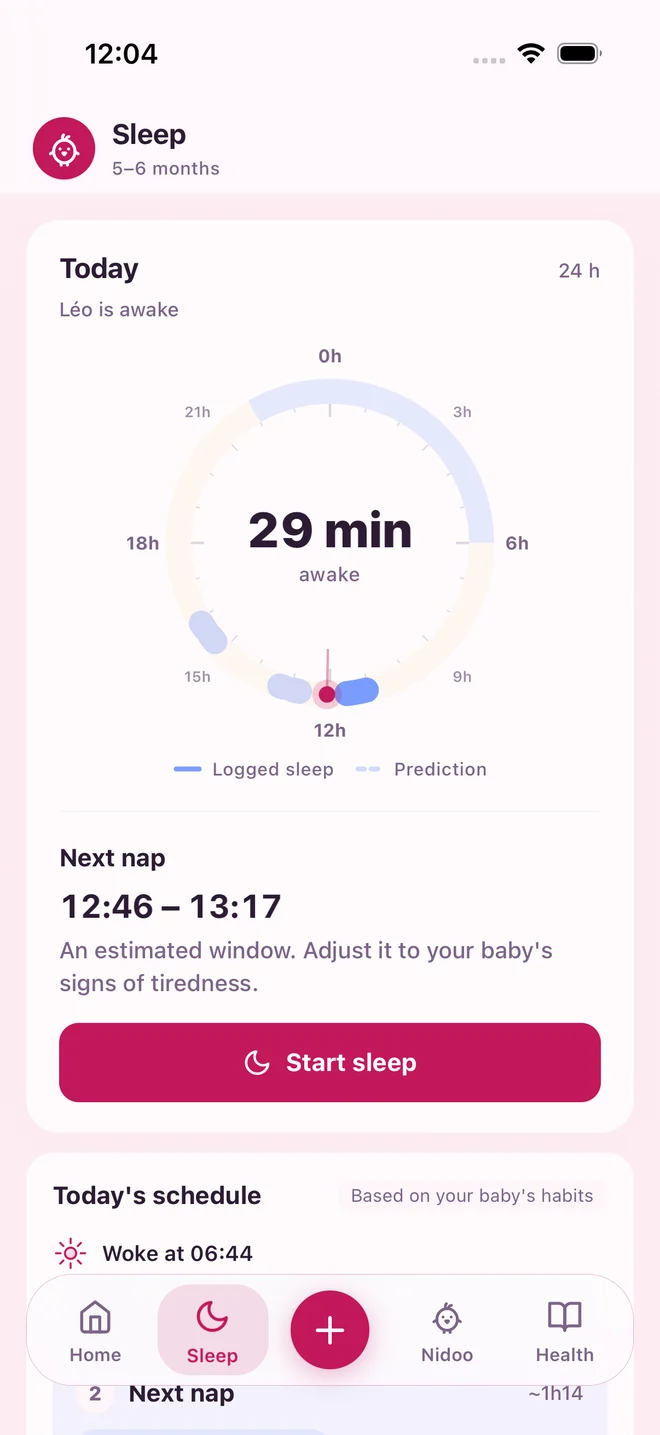
In the PetitNid app
The next nap, estimated from what you log.
Start a sleep timer with a tap and see the day on a 24-hour clock. PetitNid then suggests a window for the next nap, to adjust to your baby’s signs of tiredness.
Sleep tracking is free. Nap estimates are part of Premium.
Explore sleep tracking

Sources checked
Consulted when writing and reviewing this guide. French sources are identified by their original organisation names.
- WHO — Physical activity, sedentary behaviour and sleep under five
- Assurance Maladie (ameli.fr) — Children’s sleep: stages, duration and difficulties
- AFPA (mpedia.fr) — Baby sleep and sleep cycles
- AFPA (mpedia.fr) — Daytime naps
- France’s 1000 First Days — Baby sleep
- Assurance Maladie (ameli.fr) — Bronchiolitis: what to do
You don’t have to remember everything.
Download PetitNid to log your baby’s naps, nights and wake-ups. Sleep tracking is free for two parents; nap estimates are part of Premium.