
How many naps does a baby need at each age?
Baby naps from birth to toddlerhood: how patterns change, when naps usually disappear, and how to recognise your baby’s tiredness cues.

As babies grow, sleep becomes organised into fewer periods. Naps are part of the sleep that supports development, learning and emotional regulation. Their number changes over time, but there is no exact timetable that every baby must follow.
Nap patterns by age: broad references
The table separates recommendations for total sleep from observations about naps. Neither is a schedule to enforce.
| Age | Daytime sleep pattern | Total sleep over 24 hours |
|---|---|---|
| Birth through 3 months | Several sleep periods; the number varies | 14–17 hours |
| 4–5 months | Several sleep periods; the number varies | 12–16 hours |
| Around 6 months | About three naps in Ameli’s description; three or four in AFPA’s | 12–16 hours |
| 9–11 months | The late-afternoon nap usually disappears between 9 and 12 months | 12–16 hours |
| 12–18 months | Usually two naps, then one as the morning nap disappears between 15 and 18 months | 11–14 hours |
| 18 months to 2 years | Usually an early-afternoon nap | 11–14 hours |
The total sleep ranges are WHO recommendations, including naps: 14–17 hours from birth through three months, 12–16 hours at 4–11 months and 11–14 hours at 1–2 years. Our guide to sleep patterns by age covers the whole day and night.
For nap counts, the French sources used here become more specific from around six months. They do not give a precise count for younger babies. Your baby’s usual pattern, daytime behaviour, feeding and growth help put a record in context. Ask a healthcare professional if sleep or alertness concerns you, even if a total falls within the range.
Understanding wake windows
A wake window is simply the time your baby spends awake between sleeps. The French sources cited here do not provide the age-by-age timetable shown in many sleep guides. The 1000 First Days website recommends watching for signs such as yawning, rubbing the eyes or becoming unsettled, and offering sleep without imposing a rigid schedule.
A record may help you recognise your baby’s own pattern. It should not overrule tiredness cues: you can offer sleep before the usual time if your baby seems tired. Equally, a predicted time is not a command to make an alert baby sleep.
Our guide to baby sleep tracking apps distinguishes a nap diary from the estimates some apps generate.
Why are some naps short?
Sleep cycles change during the first months. AFPA describes cycles of about 60 minutes between two and six months, with brief waking between cycles. The sources cited here do not establish a fixed nap length at four or five months, or prove that every 30-minute nap results from this maturation.
Consider the whole picture rather than the stopwatch alone. Does your baby have other opportunities for sleep? How are feeding, comfort and alertness? Persistent tiredness or difficulty settling deserves a conversation with the professional following your baby.
Some parents notice shorter naps alongside sleep changes around four months. That description does not identify a single cause or guarantee that all short naps will resolve on their own.
The main nap transitions
From three naps to two
Assurance Maladie places the disappearance of the late-afternoon nap usually between nine and twelve months. AFPA notes that a short late-day sleep may still be needed around one year. Follow the sleep your child still needs rather than removing a nap because of a birthday.
The pattern can vary from day to day. The sources cited here do not establish a fixed number of weeks for the transition. You can keep observing tiredness and adjust opportunities for rest as the pattern changes.
Changes around eight months, including separation anxiety, may occur nearby in time. They do not automatically mean a nap should disappear.
From two naps to one
Ameli and AFPA place the disappearance of the morning nap usually between 15 and 18 months. You may find that your child no longer settles for it or that the daily pattern is changing. One refusal alone does not establish that the transition is complete.
The remaining nap generally falls in the early afternoon. AFPA suggests bringing lunch a little earlier when the morning nap disappears, so that an increasingly tired child can eat before sleeping. Some days may still call for an earlier rest; there is no need to hurry the change.
When naps stop
The afternoon nap disappears at different ages, somewhere between two and five years in the French guidance cited here. There is no single birthday when it becomes unnecessary. If your child no longer sleeps but still needs a pause, you can offer a quiet rest with a book or gentle music. Quiet time is an option, not a guarantee that it replaces missing sleep.
If your baby resists a nap
Consider the timing first. An opportunity to sleep may come before your baby is tired or after they have become very unsettled. Watching their cues can be more useful than repeatedly adjusting a rigid timetable.
A short, familiar routine, such as a song or the same bedtime phrase, may help mark the change to rest. AFPA advises keeping some daylight during daytime naps, in contrast with the darker night-time environment. Always keep the same safe sleeping arrangements.
If sleep does not come, you can pause the attempt and offer another opportunity later according to your baby’s cues. Trying for longer is not always helpful for either of you. An earlier bedtime may sometimes suit a tired child, but there is no guarantee that one adjustment will compensate for a missed nap.
If resistance persists, your baby seems continually tired, or you have concerns about feeding, growth or health, speak to their doctor.
PetitNid is not a medical device. If you are unsure, speak to your baby’s doctor.
Frequently asked questions
How long should a baby’s nap last?
The sources cited here do not set one ideal nap length. Consider sleep over the whole day and night, how your baby behaves when awake, feeding and growth. A cheerful waking is useful context, but it does not prove that every short nap is sufficient.
How many naps does a five-month-old take?
At five months, nap patterns still vary. WHO recommends 12–16 hours of sleep over 24 hours for babies aged 4–11 months, including naps. The French sources used here do not give a precise nap count for five months.
Why does my baby nap for only 30 minutes?
A short nap can have different explanations. AFPA describes sleep cycles changing during the first months, but the sources cited here do not establish a fixed nap length at four or five months. Look at the wider pattern and seek advice if your baby seems persistently tired or unwell.
When do babies move from two naps to one?
Ameli and AFPA describe the morning nap usually disappearing between 15 and 18 months. The afternoon nap may remain until somewhere between two and five years. Follow your child’s needs; there is no fixed transition length.
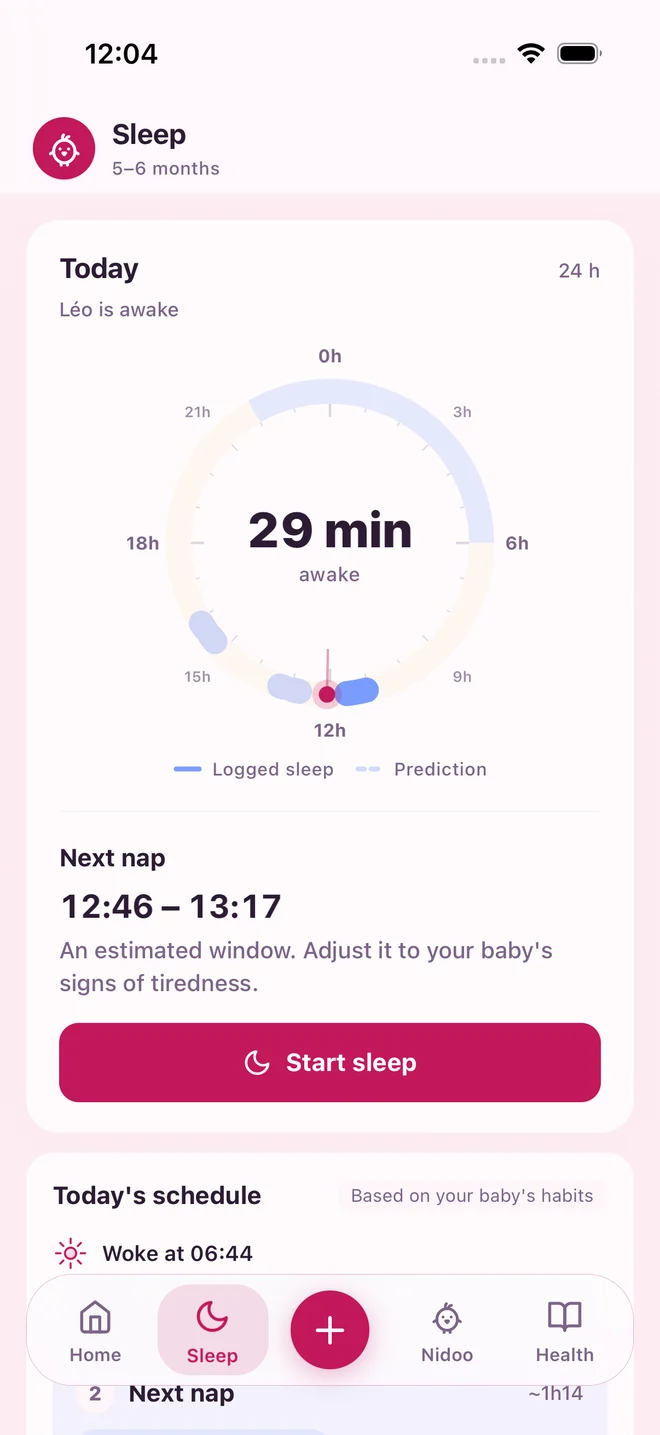
In the PetitNid app
The next nap, estimated from what you log.
Start a sleep timer with a tap and see the day on a 24-hour clock. PetitNid then suggests a window for the next nap, to adjust to your baby’s signs of tiredness.
Sleep tracking is free. Nap estimates are part of Premium.
Explore sleep tracking

Sources checked
Consulted when writing and reviewing this guide. French sources are identified by their original organisation names.
You don’t have to remember everything.
Download PetitNid to log your baby’s naps, nights and wake-ups. Sleep tracking is free for two parents; nap estimates are part of Premium.