
Choosing an app to track your baby’s sleep
What a baby sleep diary can show, six useful features to compare, and the limits of nap estimates, with a closer look at PetitNid.

You may already note naps on paper or in your phone and wonder whether an app would help. It can make records easier to share, provided it does not become another burden. This guide covers useful features, the limits of sleep estimates and how PetitNid handles sleep records.
What a sleep tracking app can do
A diary can keep the times for you. When nights are interrupted, recalling exactly when the last waking happened is difficult. A timer or a quick entry gives you something to refer to later.
Records can also show patterns across several days: a bedtime that has shifted, a late nap followed by later settling, or wake-ups around similar times. These observations do not establish causes, but may make a question easier to describe.
Shared access helps with handovers. If one parent covers the first part of the night and another takes over, a record can show what was entered while they were asleep. Check how quickly the app synchronises and what happens without a connection.
AFPA describes short infant sleep cycles: about 50 minutes from birth to two months and 60 minutes between two and six months, with brief waking between cycles. That context may help when reading a diary, but a pattern on a chart cannot diagnose why a particular baby wakes.
What a diary cannot tell you
PetitNid is not a medical device. It records caregiver entries; it does not measure breathing, heart rate, sleep depth or sleep quality. Do not assume that an app described as a tracker provides monitoring: check the specific product and any separate hardware involved.
Safe sleep depends on the sleeping environment: placing your baby on their back, using their own clear cot with a firm mattress, avoiding overheating and keeping the home smoke-free. No diary or displayed curve replaces those measures. See dressing your baby for sleep, including the French room-temperature recommendation of 18–20°C.
A nap estimate is a suggestion based on recorded information and the product’s method. It cannot know that your baby is hungry, ill, uncomfortable or already tired unless the product has information you provide. Yawning, eye rubbing and other cues take priority over the suggested time.
An app cannot establish that your baby sleeps “enough” from a total alone. WHO recommends 14–17 hours over 24 hours from birth through three months, 12–16 hours at 4–11 months and 11–14 hours at 1–2 years. A professional considers the wider picture, including alertness, feeding and growth.
Six features worth comparing
- Simple entry at night. Try the timer and correction flow. Can you record or fix a time easily with one hand?
- Sharing across your phones. Check whether both caregivers can see the same record and whether sharing works between iOS and Android.
- A language everyone understands. Buttons, reminders and explanations should be clear to the people caring for your baby.
- Offline recording. Find out which actions work without a connection and when they synchronise.
- Clearly explained estimates. An app should distinguish what was recorded from what it predicts and explain the limits.
- Clear prices and privacy information. Check the subscription, free features, storage information and account-deletion process before committing.
Comparing available apps
Our baby tracking app comparison brings together publicly announced features and links to the publishers’ sources. It is a dated snapshot of the French market, published by PetitNid; prices and availability may differ in your country. An unlisted feature means it was not established from the public information reviewed, not necessarily that it is absent.
Different products suit different priorities. Consider sleep estimates, a broader daily journal, the phones used in your household and how much recording you want to do. You can compare the current publisher information rather than assuming a paid sleep feature will suit your baby better.
PetitNid focuses on a shared baby journal, care handovers and offline recording. Version 1.2.0 adds English alongside French.
Sleep tracking in PetitNid
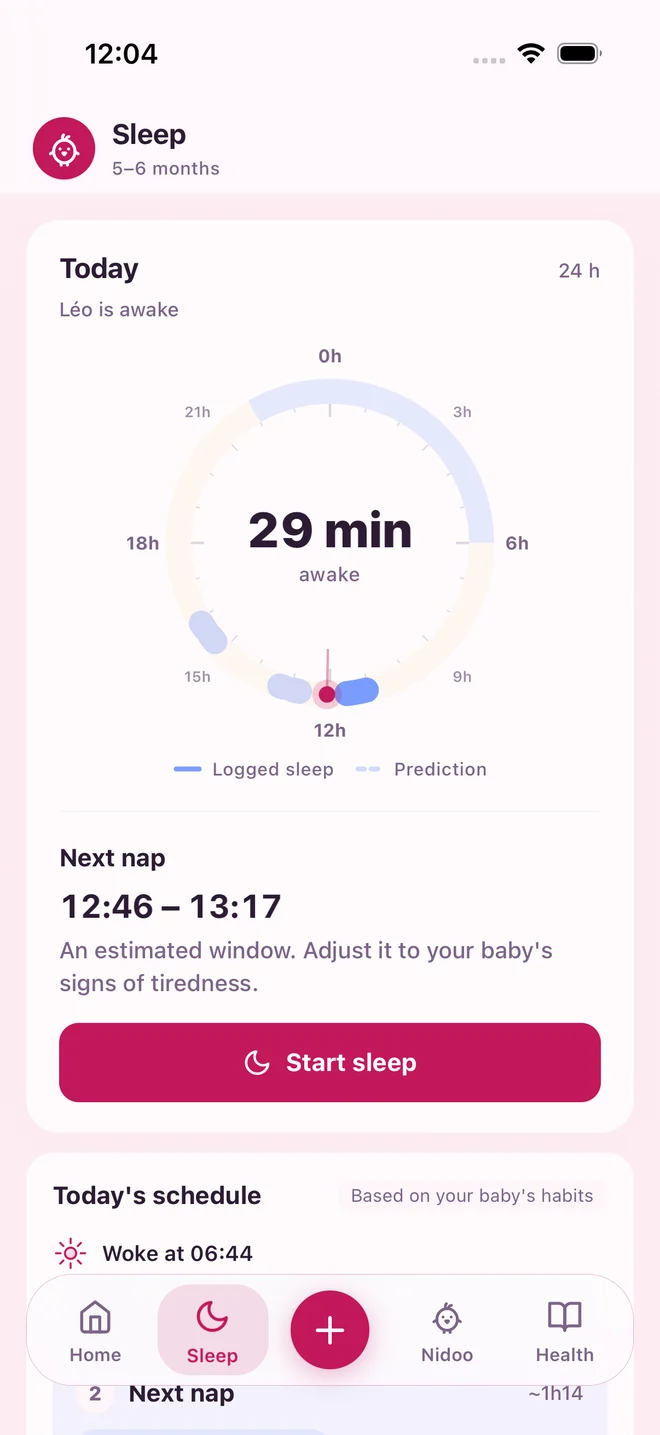
Start the sleep timer from the Sleep screen. If you started it late, you can correct the start time afterwards. The day appears on a 24-hour clock, distinguishing recorded sleep from the estimated continuation, with the time awake in the centre.
PetitNid can estimate the next nap from the sleep you have entered and age-based references. It presents this as an estimate to adjust according to tiredness cues. An optional reminder can mark the start of the estimated window.
The other parent can see the running timer on an iPhone or Android phone when synchronised. Records can be entered offline and synchronised later. Care mode pauses sleep estimates and reminders while your baby is being cared for elsewhere.
The timer, shared journal and seven-day history are included in the free plan. Sleep estimates are part of Premium; see pricing.
The limits matter: there is no sensor or baby monitor, and sleep that nobody records does not appear automatically. Start and end times do not measure sleep quality. The displayed estimate is not a medical recommendation. Each journal currently follows one baby and can be shared by up to two parents.
What you might record
For an everyday diary, useful notes can include:
- when your baby was put down and when sleep began, if you know;
- night waking, even approximately;
- nap start and end times;
- relevant context, such as illness, an outing or a change in childcare.
These are organisational suggestions, not a clinically complete record for every situation. Follow a healthcare professional’s instructions if they ask for particular observations. An approximate entry is best labelled as approximate rather than treated as a measurement.
For context, see sleep patterns by age and nap transitions.
References for reading a diary
| Age | Total sleep over 24 hours: WHO | Cycle length described by AFPA |
|---|---|---|
| Birth through 3 months | 14–17 hours | About 50 minutes from birth to 2 months |
| 4–11 months | 12–16 hours | About 60 minutes between 2 and 6 months |
| 1–2 years | 11–14 hours | About 70 minutes around 2 years |
The day–night rhythm develops gradually after the first month in AFPA’s description. Sleep changes around four months are often described by parents as a regression, but a chart cannot confirm a cause or predict its duration.
Keep tracking manageable
You can record when a question arises and pause when it no longer helps. There is no established duration here that makes a short diary equivalent to continuous tracking. Choose the amount of detail that helps your family, or follow the professional’s request if the diary is for an appointment.
Ask whether the app makes handovers easier. Returning to paper or choosing another method is reasonable if recording becomes stressful. Bring useful records to appointments as a description of what you observed, not as a diagnosis.
When to speak to your baby’s doctor
Discuss persistent mouth breathing, loud snoring, suspected breathing pauses, painful or inconsolable waking, lasting changes or your own exhaustion. You need not wait weeks if something concerns you.
Seek emergency help for increasing breathing difficulty, blue lips, or unusual drowsiness and floppiness. For a baby under two months, seek emergency help as soon as breathing becomes difficult. In France, call 15 or 112; elsewhere, call your local emergency number.
PetitNid is not a medical device. If you are unsure, speak to your baby’s doctor.
Frequently asked questions
Which sleep tracking app should I choose?
Choose according to your household: simple entry at night, a language both caregivers understand, compatible phones, clear sharing rules and offline recording if needed. PetitNid offers shared sleep records on iOS and Android, with French and English from version 1.2.0.
Can an app predict when my baby will fall asleep?
Some apps estimate a possible next sleep window from records and age-based references. An estimate is not a measurement of your baby’s sleep or a medical recommendation. Respond to your baby’s tiredness, feeding and comfort rather than treating the displayed time as a rule.
Does PetitNid monitor breathing?
No. PetitNid records what a caregiver enters. It has no breathing monitor, heart-rate sensor or automatic sleep detector. It does not replace safe sleeping arrangements or medical assessment.
How long should I keep a sleep diary?
You can record sleep for as long as it helps answer your question or share care. There is no fixed medically validated recording period in the sources cited here. If a professional asks for a diary, follow their advice about what to record and for how long.
In the PetitNid app
The next nap, estimated from what you log.
Start a sleep timer with a tap and see the day on a 24-hour clock. PetitNid then suggests a window for the next nap, to adjust to your baby’s signs of tiredness.
Sleep tracking is free. Nap estimates are part of Premium.
Explore sleep tracking

Sources checked
Consulted when writing and reviewing this guide. French sources are identified by their original organisation names.
- WHO — Physical activity, sedentary behaviour and sleep under five
- AFPA (mpedia.fr) — Baby sleep and sleep cycles
- AFPA (mpedia.fr) — Unexpected infant death
- France’s 1000 First Days — Baby sleep
- Assurance Maladie (ameli.fr) — Bronchiolitis: what to do
- AFPA (mpedia.fr) — Snoring and sleep apnoea in children
You don’t have to remember everything.
Download PetitNid to log your baby’s naps, nights and wake-ups. Sleep tracking is free for two parents; nap estimates are part of Premium.