
Four-month sleep regression: changes, duration and what helps
More waking around four months? Understand changing sleep cycles, what may help your baby settle, and when to seek medical advice.

Your baby had been sleeping more peacefully, and now, around four months, the nights feel broken again: more waking, shorter naps, harder bedtimes. Parents often call this the “four-month sleep regression”. The name describes an experience; it does not explain every change in sleep or tell you exactly when it will end.
What does four-month sleep regression mean?
The word “regression” can suggest a step backwards. Yet sleep is developing throughout infancy. AFPA, the French Association of Ambulatory Paediatrics, describes two sleep states in the first months: active sleep and quiet sleep. Between two and six months, it describes cycles of around 60 minutes containing light non-REM sleep, deep non-REM sleep and REM sleep, with brief waking between cycles.
Brief waking between cycles is part of sleep. A baby may need help settling again and call for the things that usually comfort them: your presence, feeding, contact or rocking. This does not mean that every hourly waking is caused by a specific regression. Hunger, discomfort, illness and changes in daily life can also affect sleep.
Daytime life changes too. AFPA’s developmental guidance for three to six months describes increasing visual attention, cooing, turning towards the side and reaching for objects. In an expert answer about routines, AFPA stresses how changeable sleep and waking patterns can be before six months. A routine that worked recently may need adjusting to your baby’s current needs.
Changes you may notice
Parents may describe:
- more night waking than before;
- shorter naps or difficulty settling for another sleep cycle;
- taking longer to fall asleep or waking upset;
- more frequent requests for a breastfeed or bottle;
- wanting more contact, cuddles or carrying during the day.
These observations are not a checklist for diagnosing a regression. You do not need to see all of them, and their presence does not rule out another reason for your baby’s discomfort. Look at how your baby is overall, including feeding, alertness and comfort when awake.
For the wider picture from birth onwards, see baby sleep patterns by age.
How long does it last?
The sources cited here do not give a fixed duration for a four-month sleep regression. AFPA places the gradual reorganisation of sleep cycles between two and six months. It also notes that some babies do not sleep without waking their parents until six or seven months. That observation is not a deadline, a prediction for your baby or a reason to delay seeking advice.
Sleep is counted across the whole day and night. WHO recommends 12–16 hours over 24 hours, including naps, for babies aged 4–11 months. The range allows for differences between children. AFPA also encourages parents to consider daytime behaviour rather than judging sleep only by the number of night wakings.
Later in infancy, separation anxiety and new movements may coincide with further changes. Our guide to sleep around eight months explains those developments without treating them as a fixed schedule every baby must follow.
What may help during this period
Broken nights are demanding. These ideas can give you something practical to try without imposing a rigid timetable:
- Watch for tiredness: yawning, rubbing the eyes, fussing or becoming restless. Offer sleep when those cues appear.
- In the evening, reduce light and stimulation and keep the room comfortable and quiet. A short, familiar sequence can become a useful bedtime cue.
- Keep the order of the evening broadly familiar even when the exact time changes.
- If your baby briefly stirs but remains calm and shows no hunger or discomfort, you can observe for a moment. Respond when they cry, seem uncomfortable or need feeding. A quiet voice, gentle touch or cuddle can reassure them.
- You can try putting your baby down while relaxed and still awake if that suits them. It is an option to explore, not a test they must pass.
- Share care where possible, take opportunities to rest and leave non-essential tasks for later.
The 1000 First Days guidance on sleep encourages parents to follow their baby’s rhythm. No single approach fits every family, and you can ask a midwife or doctor for support with both sleep and feeding.
If you record naps and wake-ups, a short journal may make it easier to describe what has changed. Our guide to baby sleep tracking apps explains what a record can show and the limits of sleep estimates.
When to speak to a healthcare professional
You can seek advice whenever you are concerned, especially if:
- your baby seems in pain, cries inconsolably or has breathing difficulties;
- appetite, feeding or growth worries you as well as the waking;
- the change is persistent or markedly different from their usual pattern;
- you are exhausted or finding it difficult to cope.
You do not need to wait a set number of weeks. Your own exhaustion is a valid reason to ask for help.
Seek emergency help if your baby is struggling increasingly to breathe, has pauses in breathing, blue lips, or is unusually floppy or difficult to wake. Call your local emergency number; in France, call 15 or 112.
PetitNid is not a medical device. If you are unsure, speak to your baby’s doctor.
Frequently asked questions
How long does the four-month sleep regression last?
The sources cited here do not establish a duration for a four-month sleep regression. Sleep cycles mature gradually between two and six months in AFPA’s description. A change in sleep can have several causes; ask for advice if it concerns you.
Does it happen at exactly four months?
No. Four-month sleep regression is a description parents use, not a diagnosis with a fixed starting date. AFPA describes changes in sleep cycles between two and six months, with individual variation.
Should I leave my baby to cry?
You can reassure your baby with your voice, touch or a cuddle. Briefly observing a calm baby may show whether they are settling again, but respond to crying, discomfort and hunger cues. There is no need to adopt a particular sleep method.
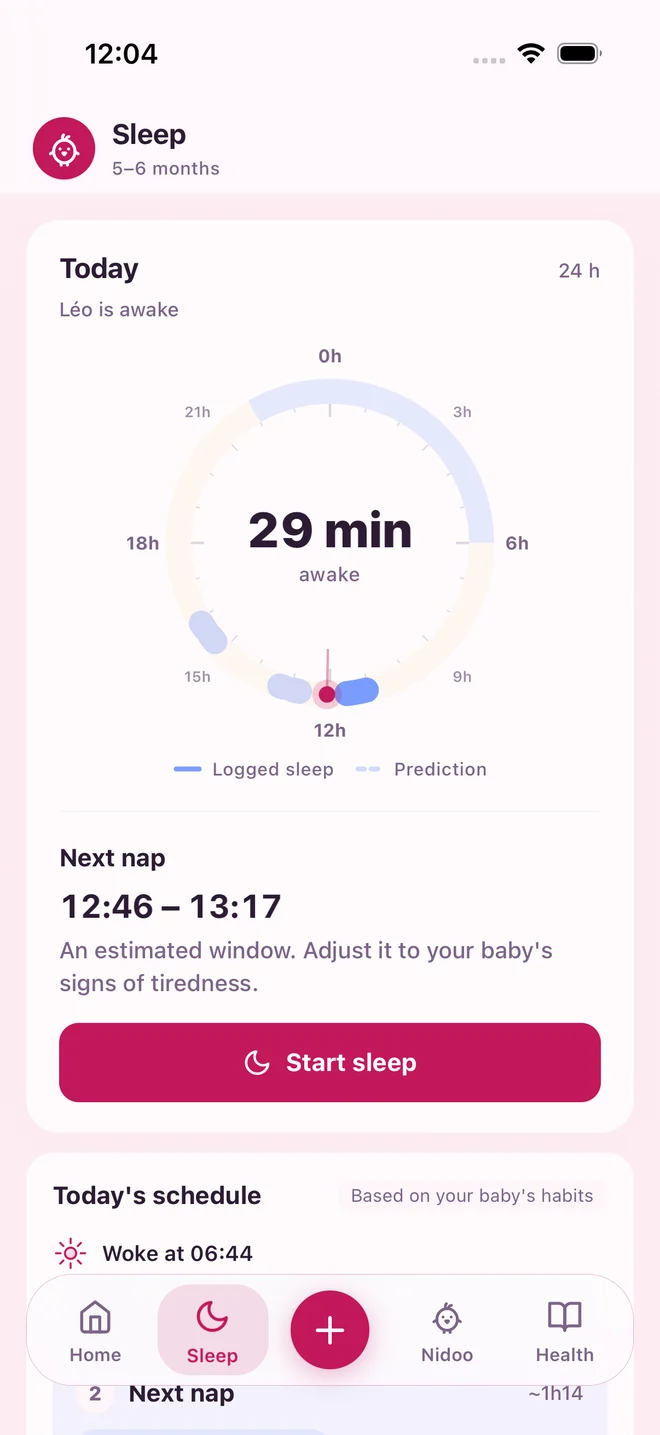
In the PetitNid app
The next nap, estimated from what you log.
Start a sleep timer with a tap and see the day on a 24-hour clock. PetitNid then suggests a window for the next nap, to adjust to your baby’s signs of tiredness.
Sleep tracking is free. Nap estimates are part of Premium.
Explore sleep tracking

Sources checked
Consulted when writing and reviewing this guide. French sources are identified by their original organisation names.
- AFPA (mpedia.fr) — Baby sleep and sleep cycles
- AFPA (mpedia.fr) — Settling difficulties and night waking
- AFPA (mpedia.fr) — Development from 3 to 6 months
- AFPA (mpedia.fr) — Restoring a sleep routine: expert answer
- Assurance Maladie (ameli.fr) — Children’s sleep: stages, duration and difficulties
- France’s 1000 First Days — Baby sleep
- WHO — Physical activity, sedentary behaviour and sleep under five
- Assurance Maladie (ameli.fr) — Bronchiolitis: what to do
You don’t have to remember everything.
Download PetitNid to log your baby’s naps, nights and wake-ups. Sleep tracking is free for two parents; nap estimates are part of Premium.