
How to help your baby fall asleep, at each age
Recognise tiredness cues, prepare a safe sleeping space and try a gentle transition from your arms to the cot, with support when settling is hard.

Some evenings your baby drifts off easily; on others, settling feels endless. A crying baby and an exhausted parent can make even familiar decisions difficult. Looking at tiredness cues, comfort and a safe sleeping space gives you a practical starting point.
Notice the first tiredness cues
AFPA advises offering sleep when a baby begins yawning, rubbing their eyes or fussing. Waiting until they are very unsettled can make the process harder, although no cue guarantees an easy bedtime.
You may notice yawning, a gaze that turns away, less interest in toys, restlessness or a greater need for contact. Learn which cues tend to accompany tiredness in your baby, while remembering that crying can also mean hunger or discomfort.
Use those cues to begin a calm bedtime routine. For the broader context of total sleep and time awake, see baby sleep patterns by age. The sources cited there do not provide a rigid timetable of wake windows.
What helps changes with age
A newborn and an older baby have different needs. AFPA describes cycles of about 50 minutes from birth to two months and around 60 minutes between two and six months, with brief waking between cycles. A brief stirring does not automatically mean something is wrong, but consider your baby’s comfort and feeding needs.
| Age | Approaches to try |
|---|---|
| Birth through 3 months | Responsive feeding, contact, carrying and gentle rocking while the caregiver is awake |
| 3–6 months | A quiet setting, familiar bedtime cues and, if it suits your baby, trying the cot while they are still a little awake |
| 6–12 months | A short, familiar bedtime routine and a calm sleeping space. Keep the cot clear of soft objects |
| From 12 months | A familiar story or song, regular opportunities for sleep and reassuring goodbyes |
These are options, not developmental targets. Needing rocking at eight months does not establish a delay, and settling alone earlier does not establish advanced development.
During the first months, falling asleep after a feed is common. AFPA describes bedtime habits becoming more relevant as a baby no longer automatically falls asleep while feeding. It places the usefulness of rituals around six to eight months, not a deadline for independent sleep.
Prepare the room, cot and light
AFPA recommends a room at 18–20°C and describes humidity around 40–50%. Avoid overheating. Our guide to sleep clothing explains choosing appropriate clothing without relying on a fixed outfit for each temperature.
Put your baby down on their back for every sleep, on a firm mattress that fits the cot. Keep loose sheets, blankets, pillows, cot bumpers and soft objects out of the infant’s sleeping space. Choose a sleep bag that fits so the head cannot slip inside. AFPA advises against loose sheets, blankets and pillows until age two; Assurance Maladie advises against duvets before age three.
AFPA distinguishes the darker night-time environment from naps with some daylight. Keep night-time interactions quiet and low in stimulation.
French guidance recommends your baby’s own cot in your room during the first six months. After six months, the 1000 First Days website says your baby may sleep in another room if this suits your home, or continue sharing your room if you prefer.
Moving from your arms to the cot
AFPA suggests trying not to wait until a baby is fully asleep before putting them down. This can help make the cot familiar as a place to settle. It is an approach you can try, not a requirement to leave a distressed baby.
You can try putting your baby down while they are relaxed but still awake, and gradually see what works for them. Keep the same safe sleeping arrangements and respond if they need you.
If it does not work tonight, you can adapt or try another time. The sources do not establish a fixed number of days or weeks for the change.
AFPA advises against a hot bath immediately before bedtime and suggests keeping the bedtime routine short. A longer ritual is not necessarily more reassuring.
When settling takes a long time
Check possible discomfort first: hunger, a nappy that needs changing, a blocked nose, pain, heat or tight clothing. A sleep timetable cannot resolve these needs.
Then consider the day’s sleep. Removing a late nap too early may not help. In its bedtime guidance, AFPA describes a nap around 18:00 as possible for an infant even with a bedtime around 20:00 or 21:00. These are examples from that guidance, not times to impose on every family. See nap patterns by age.
AFPA also cautions against rigid rules such as expecting every child to go to bed at the same time and sleep the same number of hours. Consider the whole pattern and how your baby seems when awake.
For the middle of a difficult night, see baby not sleeping at night. Sharing care, accepting help and taking opportunities to rest can make a difference to your ability to cope.
When to ask a professional
Discuss persistent inconsolable crying at bedtime, pain, marked snoring, reflux-like discomfort, daytime irritability or unusual sleepiness, or a sudden lasting change with your baby’s doctor. Your own exhaustion deserves support too.
If your baby is having increasing difficulty breathing, their lips turn blue or they are unusually drowsy and floppy, call emergency services without delay. For a baby under two months, seek emergency help as soon as they have difficulty breathing. In France, call 15 or 112; elsewhere, use your local emergency number.
Never give a baby medicine to make them sleep, including products sold without a prescription. Assurance Maladie warns that these can be dangerous.
PetitNid is not a medical device. If you are unsure, speak to your baby’s doctor.
Frequently asked questions
What can I try when my baby will not settle?
Look for tiredness, hunger and discomfort first. Dim light, a quiet voice and a short familiar routine may help. If an attempt is becoming upsetting, you can pause and try again according to your baby’s cues. Seek advice if difficulty persists or your baby seems unwell.
At what age should a baby fall asleep independently?
There is no single deadline. AFPA describes bedtime routines becoming particularly useful around six to eight months; that is not an age by which every baby must settle alone. Respond to your baby’s needs and seek support if you need it.
Should I put my baby down asleep or awake?
AFPA suggests trying to put a baby down while still a little awake, so the cot becomes familiar as a place to fall asleep. You can try this gradually. If your baby needs reassurance or feeding, respond; it is not a test they must pass.
How warm should the bedroom be?
AFPA and Assurance Maladie recommend 18–20°C. Use a correctly sized sleep bag and keep loose bedding and soft objects out of the cot. A baby who seems unwell needs assessment, not just a change in room temperature.
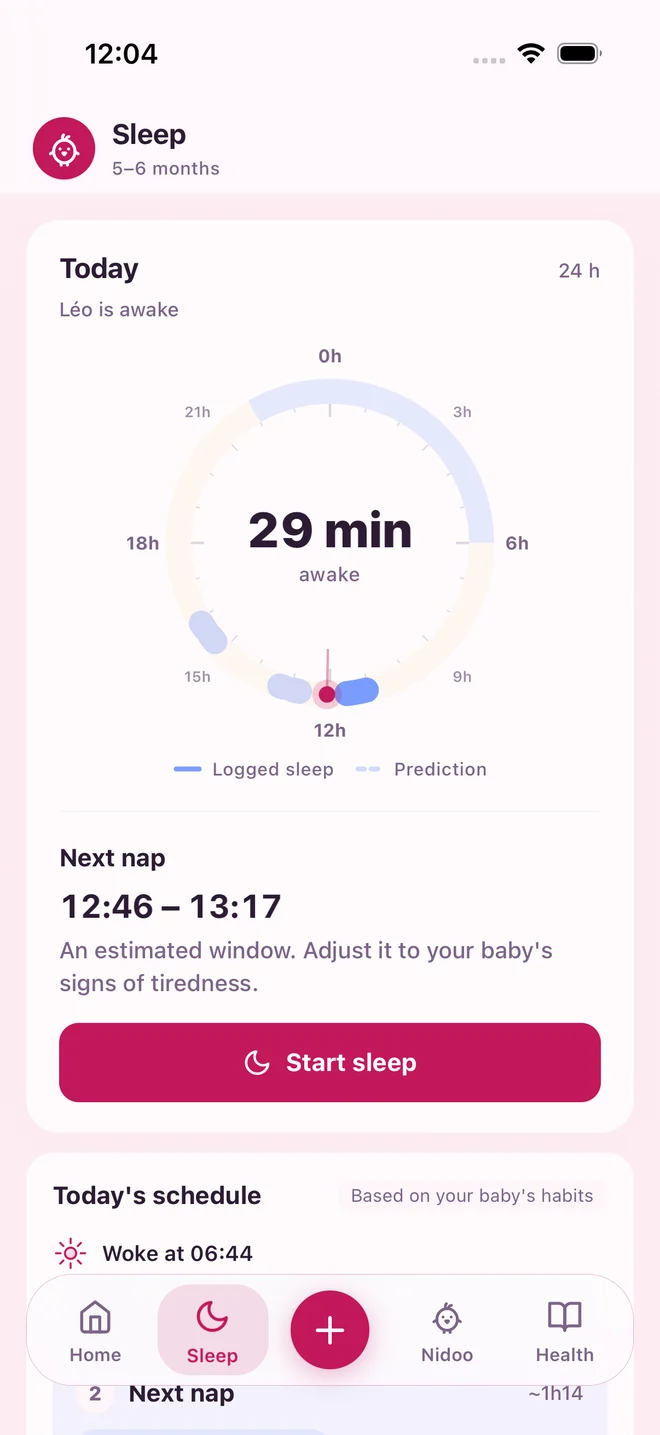
In the PetitNid app
The next nap, estimated from what you log.
Start a sleep timer with a tap and see the day on a 24-hour clock. PetitNid then suggests a window for the next nap, to adjust to your baby’s signs of tiredness.
Sleep tracking is free. Nap estimates are part of Premium.
Explore sleep tracking

Sources checked
Consulted when writing and reviewing this guide. French sources are identified by their original organisation names.
- AFPA (mpedia.fr) — Sharing a bedtime routine
- AFPA (mpedia.fr) — Putting your baby down safely
- AFPA (mpedia.fr) — Baby sleep and sleep cycles
- AFPA (mpedia.fr) — Baby bedtimes
- Naître et grandir — Baby sleep
- Assurance Maladie (ameli.fr) — Putting your baby down safely
- France’s 1000 First Days — Baby sleep
- Assurance Maladie (ameli.fr) — Bronchiolitis: what to do
You don’t have to remember everything.
Download PetitNid to log your baby’s naps, nights and wake-ups. Sleep tracking is free for two parents; nap estimates are part of Premium.