
Eight-month sleep regression: separation, naps and reassurance
Understand sleep changes around eight months, separation anxiety, developing movement and naps, with practical ways to reassure your baby.

Around eight months, nights may become unsettled after a quieter period. Your baby wakes, sits up or cries when you leave the room. Parents often call this an “eight-month sleep regression”. It is a useful description of what nights feel like, but it does not identify a single cause or a stage that every baby must go through.
Changes in emotions and movement
Around this age, separation can become more upsetting. Your baby may cry when you leave their sight and need reassurance that you will return. AFPA describes this as a period when unfamiliar faces and separation may provoke stronger reactions. It is not a sign that you have done something wrong.
Movement is developing too. AFPA describes learning to sit between roughly seven and nine months, and learning to stand later, around ten to twelve months. These are developmental references, not requirements for an eight-month-old. AFPA also describes learning to move between positions as part of motor development.
In its sleep guidance from nine months onwards, AFPA discusses how major developmental changes can accompany more waking. That does not establish a fixed link between a particular movement and a particular night. Offer opportunities to practise movements your baby can already manage, without putting them into positions they cannot reach themselves.
Other events may coincide: first teeth, often appearing between six and ten months, starting childcare, or a parent returning to work. Consider the whole situation before attributing everything to a regression.
What it can look like
You may notice some of the following:
-
night waking after a more settled period;
-
crying at bedtime or when you leave the room;
-
shorter or refused naps;
-
wanting more contact during the day;
-
greater wariness of less familiar people.
These are possible observations, not diagnostic signs. The age is approximate and experiences differ. A baby who seems unwell or feeds poorly needs medical assessment. A clear and persistent loss of a previously acquired skill needs urgent medical assessment; French guidance calls for urgent referral to hospital paediatrics or neuropaediatrics.
The label is similar to four-month sleep regression, but the developments described at these ages differ.
Does the number of naps need to change?
French guidance offers a broader picture: Assurance Maladie describes three naps around six months (morning, early afternoon and late afternoon), with the last one usually disappearing between nine and twelve months. This is not a measured rule that every eight-month-old must take three naps.
AFPA notes that around nine months a nap before the evening meal can still be useful, particularly after a short early-afternoon nap. A period of difficult nights does not, by itself, mean you should remove it.
Two practical points may help:
- Keep offering the late-afternoon nap if your baby still takes and needs it, particularly when earlier sleep was short.
- Follow tiredness cues as well as the clock. The French 1000 First Days guidance advises responding to yawning, eye rubbing and restlessness rather than enforcing fixed times.
Our guide to baby naps by age describes these transitions and the limits of age-based schedules.
Four months and eight months: different context
Both periods may involve more waking, but it is more accurate to compare the developments described in the sources than to assign every waking to a cause.
| Around four months | Around eight months | |
|---|---|---|
| Developmental context | Sleep cycles are changing between two and six months | Separation may be more upsetting; movement continues to develop |
| What parents may notice | More waking or shorter naps | Crying at separation, unsettled sleep or difficulty changing position |
| Helpful observations | Tiredness, feeding and comfort | Separation cues, current movements, feeding and comfort |
| Things to try | Familiar bedtime cues and responsive reassurance | Peekaboo, clear goodbyes and opportunities for movement during the day |
A child may show noticeable changes at both ages, one age or neither. These labels do not predict their future sleep.
How long does it last?
AFPA describes separation anxiety at this age as usually lasting no more than a few weeks. This does not set a fixed duration for every change in your baby’s sleep. There is no guarantee that mastering a movement or a particular reassurance technique will end night waking.
Sleep still includes naps as well as nights. WHO recommends 12–16 hours over 24 hours for babies aged 4–11 months. AFPA advises considering how a child behaves during the day alongside sleep records. See baby sleep patterns by age for the wider context.
Ways to offer reassurance
Repeated waking is hard on parents too. The following ideas focus on reassurance and everyday opportunities to practise movement:
- Play peekaboo or hide and reveal an object. AFPA suggests these games during this period.
- Say when you are leaving and when you will return, even for a brief move to the next room. A familiar goodbye can become part of the routine.
- Give your baby time on a safe floor space to practise movements they can already manage. Encourage them without forcing sitting or standing.
- At night, respond quietly with low light, your voice, gentle contact or a cuddle as needed.
- Keep the evening sequence reasonably familiar while allowing the timing to change with tiredness.
- Discuss sharing care before exhaustion becomes overwhelming. The 1000 First Days guidance encourages an arrangement that gives each parent opportunities for rest and sleep.
For practical help during a difficult night, see baby not sleeping at night. If you want a shared record of naps and waking, choosing a sleep tracking app covers useful features and their limits.
When to ask for help
Speak to your baby’s doctor if they seem in pain, cry inconsolably, have a fever, seem to have ear pain, feed poorly, or if growth concerns you. Discuss concerns about development with your doctor; a clear and persistent loss of a previously acquired skill needs urgent medical assessment.
Persistent sleep changes are also worth discussing. You do not have to wait for a supposed regression to end, and feeling exhausted is enough reason to seek support.
PetitNid is not a medical device. If you are unsure, speak to your baby’s doctor.
Frequently asked questions
How long does an eight-month sleep regression last?
AFPA describes separation anxiety at this age as usually lasting no more than a few weeks. This does not set a fixed duration for every change in sleep. If waking, feeding, discomfort or your own exhaustion concerns you, ask for support.
Why does my baby cry when I leave the room?
Separation can become more upsetting around this age. Your baby may cry when you leave their sight and need reassurance that you will return. This is one possible explanation; consider hunger, pain and other needs too.
Should I remove a nap around eight months?
A period of waking does not itself mean a nap needs removing. French guidance describes three naps around six months and the late-afternoon nap usually disappearing between nine and twelve months. Follow your baby’s tiredness and the naps they still need.
Could teething be involved?
First teeth often appear between six and ten months and may cause discomfort. Teething and separation anxiety can happen around the same time, but neither should automatically be assumed to explain all night waking or illness symptoms.
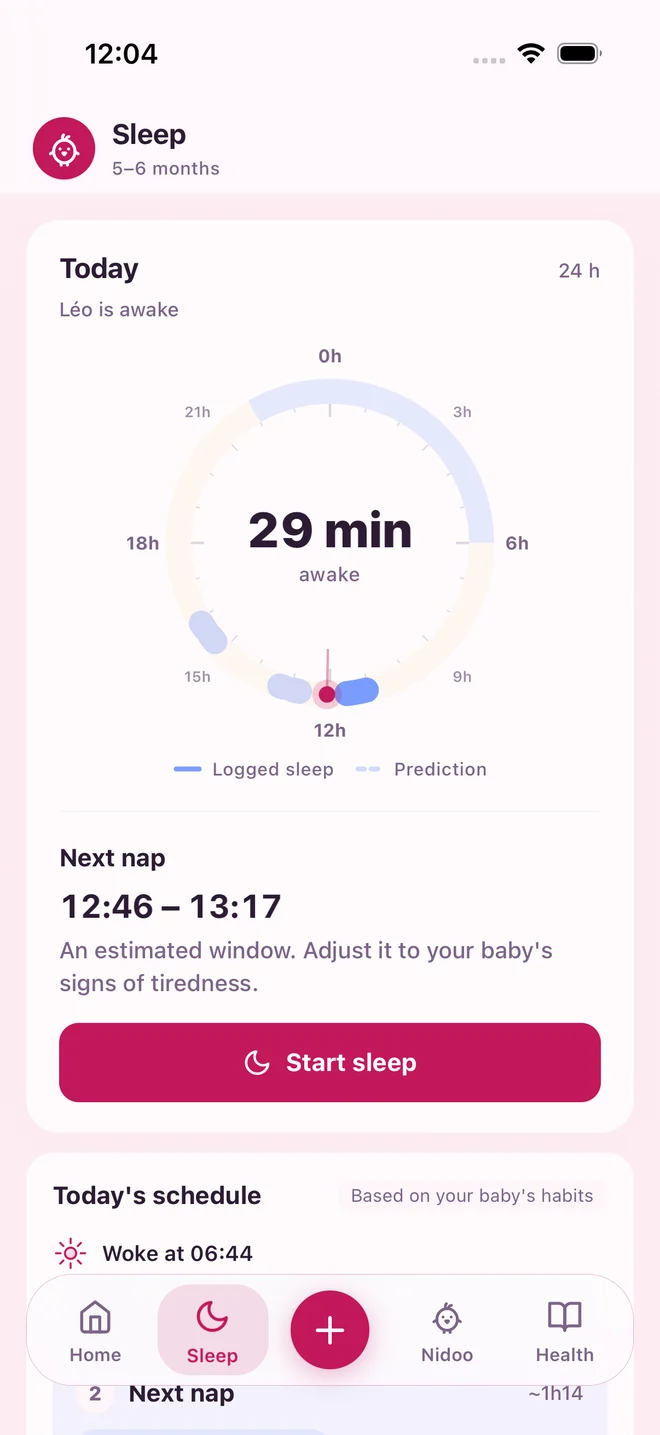
In the PetitNid app
The next nap, estimated from what you log.
Start a sleep timer with a tap and see the day on a 24-hour clock. PetitNid then suggests a window for the next nap, to adjust to your baby’s signs of tiredness.
Sleep tracking is free. Nap estimates are part of Premium.
Explore sleep tracking

Sources checked
Consulted when writing and reviewing this guide. French sources are identified by their original organisation names.
- French developmental screening guidance — Loss of acquired skills (2024)
- AFPA (mpedia.fr) — Separation anxiety around eight months
- AFPA (mpedia.fr) — Development from 6 to 9 months
- AFPA (mpedia.fr) — Development from 9 to 12 months
- AFPA (mpedia.fr) — Settling difficulties and night waking
- Assurance Maladie (ameli.fr) — Children’s sleep: stages, duration and difficulties
- AFPA (mpedia.fr) — Daytime naps
- AFPA (mpedia.fr) — Should you wake your baby?
- AFPA (mpedia.fr) — Baby sleep and sleep cycles
- AFPA (mpedia.fr) — Teething
- France’s 1000 First Days — Baby sleep
- WHO — Physical activity, sedentary behaviour and sleep under five
You don’t have to remember everything.
Download PetitNid to log your baby’s naps, nights and wake-ups. Sleep tracking is free for two parents; nap estimates are part of Premium.