
How many breastfeeds a day does a baby need?
Breastfeeding frequency, bottle-feeding references and hunger cues from birth to twelve months, with signs that call for feeding support.

During the first month, breastfed babies commonly feed 8–12 times over 24 hours, including at night. For formula feeding, AFPA gives an average reference of 6–8 bottles. These numbers offer context; feeding should respond to your baby’s needs and any individual medical advice.
Breastfeeding during the first weeks
Offer the breast in response to early feeding cues rather than waiting for a fixed time or for crying. AFPA describes blinking, small hand movements and mouth or tongue movements as early waking signs when you can offer a feed.
Some newborns are sleepy. If your baby is difficult to wake, feeds very little or seems unusually unresponsive, seek medical advice immediately rather than assuming sleepiness is harmless. The maternity team or professional following your baby can advise when to wake them for feeds.
Santé publique France’s breastfeeding guide gives 8–12 feeds over 24 hours in the early weeks and does not set a maximum number or a fixed interval. Frequent, effective feeding helps establish milk production.
A feed’s length varies. AFPA describes a whole feed lasting around five minutes for some babies and 30–40 minutes for others. These are not targets per breast. Effective attachment, swallowing, comfort and how feeding is going overall are more useful than a timer alone.
How breastfeeding patterns change
The sources do not provide a month-by-month quota after the first month. Santé publique France lists frequent, effective feeding, generally at least 6–8 times in 24 hours after the first month, among reassuring signs; AFPA describes the following broad evolution:
| Age | Pattern described by AFPA |
|---|---|
| First month | Commonly 8–12 breastfeeds over 24 hours, responsively |
| 1–3 months | A slight reduction unless feeds are already six or fewer; feeds may become shorter and the longest gap may increase |
| After 3 months, while exclusively breastfeeding | Relatively little change in frequency |
The longest interval may increasingly occur at night between two and four months, but this is not a reason to remove a feed your baby needs. Growth, health and individual feeding advice remain relevant.
WHO recommends exclusive breastfeeding for six months, then complementary foods alongside continued breastfeeding to two years or beyond. It notes that breast milk can provide half or more of energy needs between six and twelve months. French complementary-feeding guidance uses a four-to-six-month starting window; see when to start solids for that distinction and individual advice.
Bottle-feeding references
For healthy, full-term babies fed formula, AFPA publishes the following averages. Mixed feeding needs individual adjustment because breastfeeds contribute too.
| Age | Bottles over 24 hours | Amount per bottle | Daily reference total |
|---|---|---|---|
| Birth to 1 month | 6–8 | 60–90 ml | 420–720 ml |
| 1–2 months | 5–7 | 90–120 ml | 540–840 ml |
| 2–3 months | 5–6 | 120–150 ml | 600–900 ml |
| 3–4 months | 5 | 150–180 ml | 750–900 ml |
| 4–6 months | 4–5 | 180 ml | 720–1,000 ml |
| 6–12 months | 3–4 | Depends on complementary foods | About 500–800 ml of milk or dairy equivalents |
The daily totals are AFPA’s separate reference ranges, not the exact products of the neighbouring columns. After six months they include milk and dairy equivalents. Do not turn them into amounts your baby must finish.
For a weight-based reference and its limitations, see milk amounts by age and weight. If your baby turns away or slows down, they may be full or need a pause. Persistent refusal, poor intake or signs of illness need advice.
Signs to discuss with a professional
Nappies, growth and behaviour give information together. AFPA describes 5–6 heavily wet nappies per day from day four or five in a breastfed baby feeding effectively. Santé publique France similarly refers to heavy wet nappies. This is a reassuring observation, not a diagnostic test.
For breastfed babies in the first month, Santé publique France describes more than three soft, yellow stools over 24 hours among reassuring signs; stool frequency may decrease from around four to six weeks. Ask for advice about changes that concern you, especially alongside poor feeding or other symptoms.
The doctor follows your baby’s growth over time. A lower percentile can be compatible with health, but the curve must be interpreted with the examination and feeding history. Alertness during waking periods is another useful observation; it does not replace assessment if intake concerns you.
Hunger and fullness cues
Early hunger cues can include hands moving to the mouth, sucking movements and turning the head with the mouth open. They do not appear in one fixed order. Crying may be a later cue, and a distressed baby may need calming before feeding comfortably.
Slowing down, stopping or turning away can indicate fullness or a need for a pause. Do not force a bottle to be finished. If refusal continues, your baby takes very little or seems unwell, seek advice rather than assuming they are simply full.
When the pattern changes
Some babies have periods of more frequent feeding. In an expert answer, AFPA mentions growth-spurt periods around three and six weeks and three and six months, lasting a few days. Those are indicative observations, not a diagnostic calendar. See baby growth spurts.
As routines develop, the longest gap between feeds may change. Starting complementary foods also changes the day, while milk remains important. Keep breastfeeding responsively; bottle amounts depend on appetite and the advice of the professional following your baby.
If sleep changes at the same time, sleep patterns by age gives context without assuming that every waking is due to hunger.
Combining breast and bottle feeding
Mixed feeding may be a choice or a response to circumstances. AFPA’s advice includes:
- waiting until around six weeks before a first bottle where possible, while recognising that individual needs may require a different plan;
- replacing feeds gradually, keeping morning, evening and night breastfeeds where they suit the family;
- maintaining around six breastfeeds or expressions daily before three months and three after that age to support milk production;
- adjusting bottles to what breastfeeding already provides rather than using a fixed conversion.
A midwife or lactation professional can help plan changes. Do not postpone clinically needed supplementation to meet a general timetable.
For expressed milk, the French storage references described in storing breast milk and formula include 48 hours in a refrigerator at 4°C or below and four months at −18°C. Follow the full hygiene and storage conditions, and local advice outside France.
Sharing feeding records offers a simple way to record handover information without turning every feed into a detailed report.
When to ask for support
In an expert answer, AFPA describes regaining birth weight by around ten days; ask for advice if your baby has not done so.
Ask promptly about weight loss, slow growth, painful feeding, feeds that seem ineffective, or concerns about milk supply. You do not need to wait for several poor measurements before raising a concern.
Seek medical advice immediately if your baby is unusually drowsy, difficult to wake, less responsive or passing very little urine. If your baby seems seriously unwell, call your local emergency number; in France, 15 or 112.
PetitNid is not a medical device. If you are unsure, speak to your baby’s doctor.
Frequently asked questions
How often does a newborn feed?
Breastfed newborns commonly feed 8–12 times over 24 hours, by day and night, without a fixed interval. AFPA gives 6–8 bottles of 60–90 ml as an average first-month reference for healthy, full-term formula-fed babies. These are references, not a schedule or a requirement to finish a bottle.
How can I tell if my baby is getting enough milk?
A professional considers feeding, growth, alertness and nappies together. AFPA describes 5–6 heavily wet nappies a day from day four or five in a breastfed baby feeding well. This is a reassuring sign, not a diagnostic cutoff or a substitute for assessment.
Do feeds become less frequent as babies grow?
AFPA describes a slight reduction between one and three months, unless the baby already feeds six times a day or fewer. There is relatively little change afterwards while breastfeeding remains exclusive. Individual patterns vary.
Can I combine breastfeeding and formula?
Yes. AFPA recommends making changes gradually and describes six breastfeeds or expressions a day before three months, then three after that age, to help maintain milk production in mixed feeding. These are general references; a midwife or lactation professional can help adapt the plan.
In the PetitNid app
Track feeds without counting in your head.
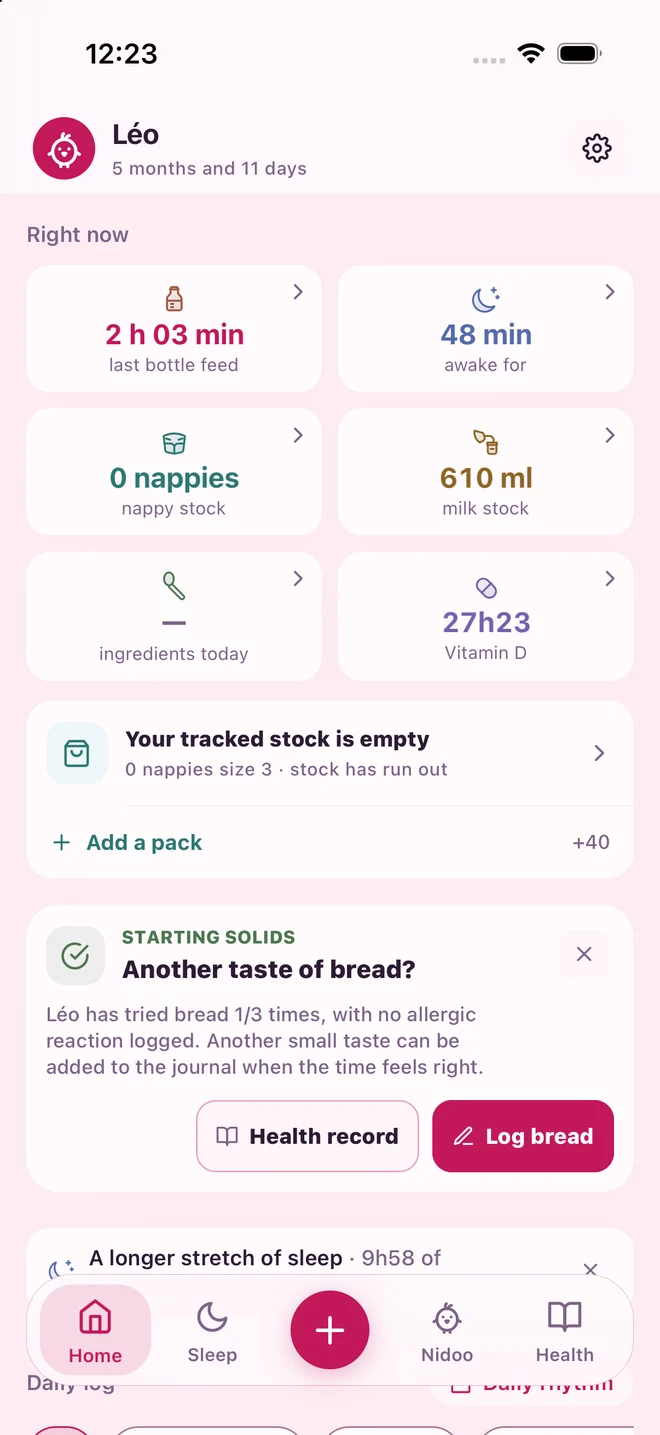
A timer tracks a breastfeed or bottle, with breast side and amount drunk. The home screen shows time since the last feed and how much milk is left in stock.
Breastfeeding and bottle tracking are free. Milk stock insights are part of Premium.
Explore breastfeeding and bottle tracking

Sources checked
Consulted when writing and reviewing this guide. French sources are identified by their original organisation names.
- AFPA (mpedia) — Breastfeeding and early weight changes
- AFPA (mpedia.fr) — Breastfeeding frequency and duration
- AFPA (mpedia.fr) — Milk amounts by age
- AFPA (mpedia.fr) — When breastfeeding is difficult
- AFPA (mpedia.fr) — Combining breast and bottle feeding
- France’s 1000 First Days — Getting started with breastfeeding
- Santé publique France — Breastfeeding guide (2023)
- WHO — Infant and young child feeding
- HAS — Breastfeeding in the first six months
- Assurance Maladie (ameli.fr) — Dehydration: symptoms and urgent help
You don’t have to remember everything.
Download PetitNid to log breastfeeds, breast side and bottles. Feed tracking is free, and the other parent can see what you log.