
How to dress your baby for sleep
How to dress your baby for sleep: French room-temperature guidance, choosing a sleep bag and recognising when your baby needs medical advice.

“Are they warm enough?” and “Are they too warm?” can both come to mind at bedtime, especially when the weather changes. The room temperature and how your baby feels at the back of the neck offer useful information. Neither replaces checking their temperature or seeking advice if they seem unwell.
Choosing sleep clothing
French health guidance recommends a room temperature of 18–20°C. Use sleep clothing suited to the room and a sleep bag that fits your baby’s size. Avoid adding too many layers: check the back of their neck for sweating. If you are unsure how to dress your baby, ask the health professional who follows their care, especially for a newborn or a baby born prematurely.
The sources cited here do not establish an exact outfit for every two-degree temperature band. Clothing thickness varies, as does the warmth of sleep bags. A fixed list of layers could give misleading reassurance.
Once you have advice appropriate to your baby and your home, sharing it with the other people caring for them can make evenings simpler. Reconsider the clothing when the room conditions change rather than automatically repeating yesterday’s outfit.
Check the neck rather than hands alone
Cool hands or feet alone do not mean your baby is too cold. The back of the neck is useful for checking whether they are sweating or seem too warm.
Sweating can mean your baby is too warm. Reduce excess clothing and consider the room temperature. If sweating keeps happening despite lighter clothing, ask a health professional for advice. Do not assume that repeated sweating is always caused by clothing.
If your baby’s body feels unusually cold, check their temperature and seek medical advice promptly if it is low or they seem unwell. If your baby has a low temperature and is unconscious, very lethargic, refusing feeds, or breathing very slowly or irregularly, call emergency services immediately: in France, 15 or 112; elsewhere, your local emergency number.
Use a correctly sized sleep bag
An infant’s cot should have a firm mattress that fits the cot, with a fitted sheet. Keep pillows, duvets, blankets, cot bumpers, soft toys and positioning devices out of the sleeping space.
A sleep bag provides warmth without loose bedding. Choose one that fits your baby’s size, so that their head cannot slip inside it. A bag that is too large can allow the baby to slide down inside. It does not remove every risk simply because it is called a sleep bag.
Assurance Maladie advises against duvets before three years. Other advice about bedding has its own age limits; none of it means loose bedding is appropriate in a young baby’s cot.
Other safe-sleep measures belong together: put your baby down on their back for every sleep, on a firm mattress, in their own cot in your room for the first six months, and keep the home smoke-free.
Check the cot itself
- Use a firm mattress of the correct size, without gaps around the edges.
- Use a fitted sheet that stays securely in place.
- In a travel cot, use the supplied mattress; do not add a second mattress for comfort.
- If using a bedside cot, ensure the attachment is secure and there is no gap next to the adult bed.
- French guidance recommends your baby’s own cot in your room during the first six months. Return them to their cot before you go back to sleep after feeding or comforting them.
- Varying the direction your baby faces in the cot can encourage them to turn their head both ways while still being put down on their back.
Once your baby can turn over independently, continue putting them down on their back, but do not force them to stay in that position or use devices to hold them there.
What about hats?
At home, remove a hat for sleep. The head is an important route for losing heat, and covering it can contribute to overheating. A hat for going outdoors in cold weather, or one used immediately after birth on the maternity team’s advice, is a different situation.
During hot weather
The aim is to reduce excess heat and watch for signs that your baby needs help.
- Keep shutters or curtains closed against daytime heat.
- Open windows to cool the room when the air outside is cooler than the air indoors, keeping your baby safely away from open windows.
- Reduce excess clothing while keeping the same clear, safe sleeping space. During very hot weather, Santé publique France describes a nappy alone as an option indoors; do not add a covering sheet.
- Offer breastfeeds more frequently. AFPA’s French guidance for formula-fed babies discusses additional feeds and small amounts of water between milk feeds during heat; ask the professional following your baby for advice appropriate to their age and your local guidance. Never dilute formula beyond its instructions.
- Santé publique France advises cooling the face and body with sprayed water, with gentle air movement to help evaporation.
If your baby has warning signs during hot weather, such as fewer wet nappies, dark urine, rapid breathing or unusual drowsiness or agitation, move them to a cool room and seek medical help without delay. Santé publique France advises breast milk for a breastfed baby or an oral rehydration solution in this situation.
If your baby is hard to wake, cannot or will not drink, has an unusual skin colour, has a high fever or seems seriously unwell, call emergency services immediately: in France, 15 or 112; elsewhere, your local emergency number. Plain water is not the same as an oral rehydration solution.
For practical support through an unsettled night, see baby not sleeping at night.
When to seek medical advice
Do not add extra layers to a feverish baby. Seek urgent medical assessment for any fever in a baby under three months. At any age, seek urgent help if your child’s general condition deteriorates, they refuse fluids, become unusually sleepy, have difficulty breathing, show dehydration, or have other worrying symptoms such as a stiff neck.
Persistent sweating despite light clothing, prematurity, low birth weight or uncertainty about temperature regulation are reasons to discuss individual advice with your baby’s doctor or midwife.
For sleep duration and changing cycles, see baby sleep patterns by age.
PetitNid is not a medical device. If you are unsure, speak to your baby’s doctor.
Frequently asked questions
What temperature should my baby’s bedroom be?
Assurance Maladie and AFPA recommend 18–20°C and daily ventilation. Choose clothing suited to the room and your baby. Ask for individual advice for a newborn, a baby born prematurely or if you are unsure.
How can I tell if my baby is too warm or cold?
Check the back of the neck for sweating. Cool hands or feet alone do not mean your baby is too cold. If their body feels unusually cold, check their temperature and seek medical advice promptly if it is low or they seem unwell. A low temperature with marked drowsiness, refusal to feed, or very slow or irregular breathing needs emergency help.
Should my baby wear a hat to sleep?
Not at home. Covering the head during sleep can contribute to overheating. A hat for going outdoors in cold weather is different from sleep clothing.
Can I put a blanket in the cot?
Keep loose bedding out of an infant’s cot. Use a correctly sized sleep bag so that the baby’s head cannot slip inside. Assurance Maladie advises against duvets before three years; do not treat that age as permission to add other loose bedding to an infant’s cot.
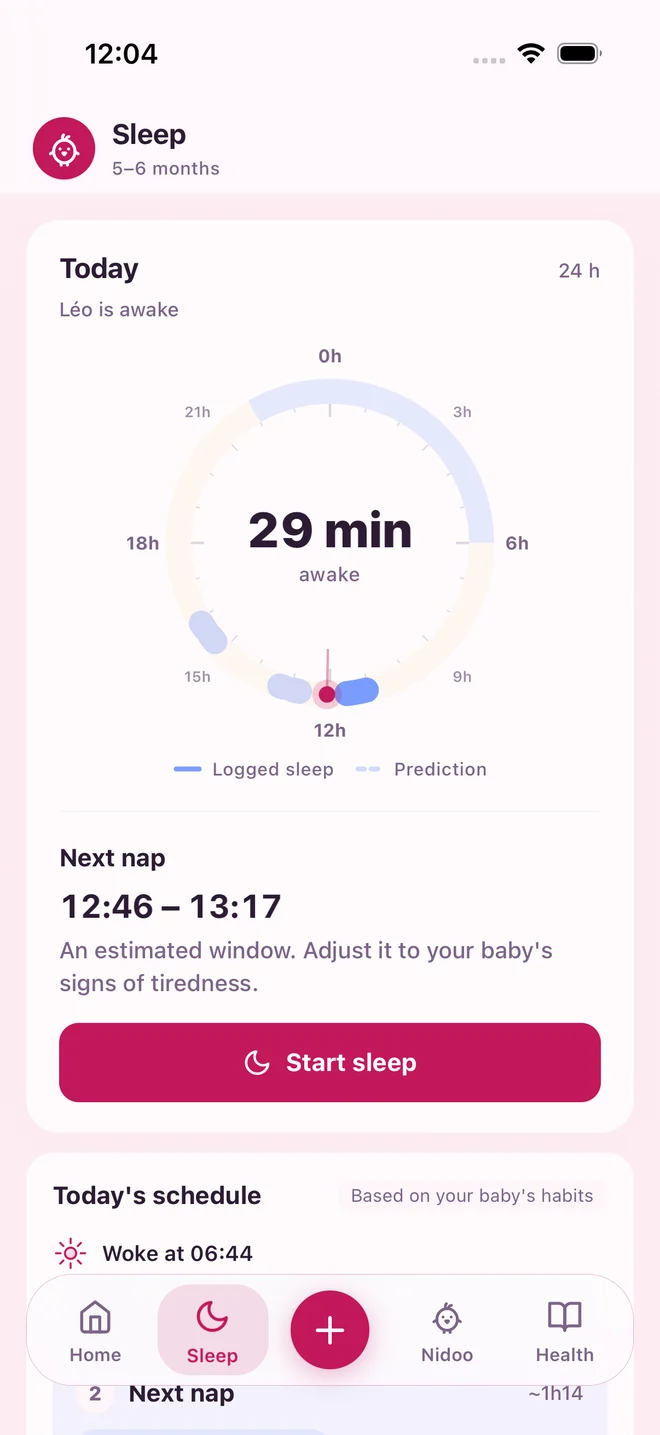
In the PetitNid app
The next nap, estimated from what you log.
Start a sleep timer with a tap and see the day on a 24-hour clock. PetitNid then suggests a window for the next nap, to adjust to your baby’s signs of tiredness.
Sleep tracking is free. Nap estimates are part of Premium.
Explore sleep tracking

Sources checked
Consulted when writing and reviewing this guide. French sources are identified by their original organisation names.
- Assurance Maladie (ameli.fr) — Putting your baby down safely
- AFPA (mpedia.fr) — Dressing your baby at night
- AFPA (mpedia.fr) — Unexpected infant death
- AFPA (mpedia.fr) — Putting your baby down safely
- AFPA (mpedia.fr) — Water for babies under six months
- Assurance Maladie (ameli.fr) — Fever in children: when to seek medical help
- Santé publique France — Protecting children in hot weather
- AFPA (mpedia.fr) — Low body temperature in babies
- Naître et grandir — Baby clothing
- AFPA (mpedia.fr) — Dressing a newborn
You don’t have to remember everything.
Download PetitNid to log your baby’s naps, nights and wake-ups. Sleep tracking is free for two parents; nap estimates are part of Premium.