
Baby not sleeping at night: help for tonight and beyond
Practical support for a difficult night: checking comfort, calming the setting, sharing care and recognising when your baby needs medical help.

It is still dark, your baby is awake again, and you have little energy left to work out why. The first part of this guide is for the next few hours. Thinking about the coming weeks can wait until you have support and some rest.
Tonight: practical things to try
- Check what may be uncomfortable: hunger, a full nappy, too much warmth, a blocked nose, painful gums or clothing that is tight.
- Keep the setting dim and quiet. Use a low voice and slow movements, without turning the waking into playtime.
- Offer reassurance through your voice, gentle contact or holding your baby while you remain awake.
- Check the room and clothing. Assurance Maladie recommends 18–20°C and avoiding too many layers. The back of the neck should not be sweaty.
- If you can share night care, agree on an arrangement that gives each parent a chance to rest. If you are alone, focus on essentials and seek help when available.
- If tension is rising, put your baby safely on their back in their cot and leave the room briefly to calm down. Ask another safe adult to take over if possible. Never shake your baby. In France, 119 is available around the clock if you fear you may shake your baby; outside France, seek local urgent support. If your baby may already have been shaken or injured, call emergency services immediately.
Sometimes the cause is not obvious. That does not mean you must keep trying more and more techniques. You can keep interactions simple while remaining responsive to hunger, distress and any signs of illness.
Turning on bright lights or repeatedly stimulating a baby can make returning to sleep harder. Avoid unnecessary activity, but do not delay a needed feed or ignore discomfort to preserve a routine.
What may contribute to night waking
Infant sleep is organised into short cycles. Brief waking between them is common, and a baby may need reassurance or feeding before settling again. Sleep patterns by age explains the approximate cycle lengths and total sleep ranges.
Other factors may include:
- hunger, including night feeds during infancy;
- digestive discomfort;
- teething discomfort;
- illness, fever, ear pain or a blocked nose;
- changes in development or routine;
- tiredness after a busy day;
- a day–night rhythm that is still developing.
These are possibilities, not a way to diagnose the cause at home. Some parents call changes around four months a sleep regression, but the label does not establish why your baby is waking or how long it will last.
If your main question is whether waking is usual at this age, see baby not sleeping through the night.
Over the coming weeks
Patterns develop gradually. No habit guarantees a full night, but familiar cues may help you and your baby find a workable rhythm.
Watch for yawning, eye rubbing and restlessness, and use those cues to begin a calm bedtime routine. During the day, allow daylight and normal household sounds. In the evening, lower the light and reduce stimulation.
A short sequence repeated in roughly the same order can become familiar: a feed when needed, changing into sleep clothing, a quiet song and the cot. The exact sequence can fit your family and your baby’s needs.
You can try putting your baby down while relaxed but still a little awake, and gradually see what works. If your baby needs feeding or comfort, respond. See helping your baby fall asleep.
Keep safe sleep arrangements for every sleep:
- put your baby down on their back on a firm mattress;
- use a correctly sized sleep bag and keep pillows, blankets, duvets and cot bumpers out;
- keep the room comfortably temperate and smoke-free;
- use your baby’s own cot in your room for the first six months, rather than sharing the adult bed.
Our guide to sleep clothing explains the French temperature guidance and signs to watch for. A timetable should never take priority over feeding, comfort or medical needs.
Looking after yourself too
Repeatedly interrupted sleep is hard to carry. Needing rest does not say anything about your ability as a parent. Accept practical help, reduce non-essential tasks and take opportunities to rest when someone safe can care for your baby.
If you share care, discuss the arrangement while you are both awake rather than trying to decide during a difficult waking. A shared journal may help the next caregiver know what happened. See using a sleep tracking app for useful features and limits.
Say clearly when you are struggling. A doctor, midwife or child health professional can help you find support; you do not need to prove that the nights are difficult enough.
When to seek medical advice
Ask promptly if your baby seems in pain, cries inconsolably, has markedly different crying, snores loudly or seems to pause breathing during sleep, feeds poorly, or if growth concerns you. Persistent sleep disruption and fear about your own reactions also deserve support.
Call emergency services without delay for increasing breathing difficulty, blue lips, or unusual drowsiness and floppiness. For a baby under two months, seek emergency help as soon as breathing is difficult. In France, call 15 or 112; elsewhere, use your local emergency number.
Any fever in a baby under three months needs urgent medical assessment. Do not assume it is caused by poor sleep or teething.
In France, your doctor, midwife or PMI service (the maternal and child health service) can also help with ongoing sleep and parenting support.
PetitNid is not a medical device. If you are unsure, speak to your baby’s doctor.
Frequently asked questions
What can I do when my baby is awake and I am exhausted?
Check hunger, the nappy, heat, a blocked nose and possible pain. Keep the setting quiet and dim. If another caregiver is available, agree on an arrangement that gives each of you a chance to rest. If you feel overwhelmed, put your baby safely on their back in their cot and step away briefly to calm down.
At what age do babies stop waking at night?
There is no single age. Waking may continue after six months and into toddlerhood. Waking alone does not establish a problem, but discomfort, breathing difficulties, feeding or growth concerns should be discussed with a professional.
Should I wake a baby whose days and nights seem reversed?
Rather than trying to enforce a sleep schedule, use daylight and normal household sounds during the day and a quiet, dim setting at night. If your baby has specific feeding or medical needs, follow the professional’s advice about waking for feeds.
When should I seek medical help?
Ask about pain, inconsolable crying, feeding or growth concerns, persistent sleep changes or your own exhaustion. Seek emergency help for increasing breathing difficulty, blue lips or unusual drowsiness and floppiness; any breathing difficulty under two months needs urgent help. Fever under three months needs urgent medical assessment. In France, call 15 or 112 for an emergency; elsewhere, use your local emergency number.
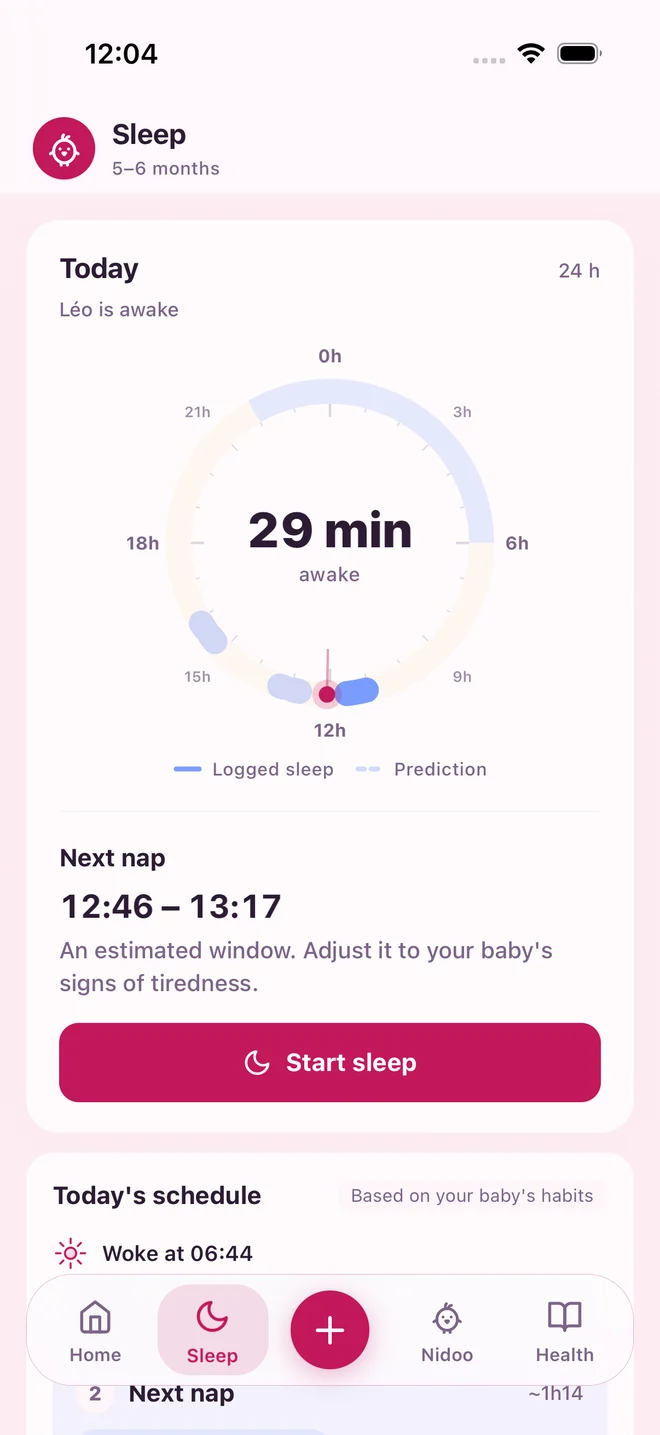
In the PetitNid app
The next nap, estimated from what you log.
Start a sleep timer with a tap and see the day on a 24-hour clock. PetitNid then suggests a window for the next nap, to adjust to your baby’s signs of tiredness.
Sleep tracking is free. Nap estimates are part of Premium.
Explore sleep tracking

Sources checked
Consulted when writing and reviewing this guide. French sources are identified by their original organisation names.
- AFPA (mpedia.fr) — Baby sleep and sleep cycles
- AFPA (mpedia.fr) — Helping your baby sleep at night
- Assurance Maladie (ameli.fr) — Putting your baby down safely
- Naître et grandir — Baby sleep
- France’s 1000 First Days — Baby sleep
- Assurance Maladie (ameli.fr) — Shaken baby syndrome
- Assurance Maladie (ameli.fr) — Bronchiolitis: what to do
- Assurance Maladie (ameli.fr) — Fever in children: when to seek medical help
- Assurance Maladie (ameli.fr) — Sleep difficulties in children
You don’t have to remember everything.
Download PetitNid to log your baby’s naps, nights and wake-ups. Sleep tracking is free for two parents; nap estimates are part of Premium.