
Baby not sleeping through the night: understanding the pattern
What sleeping through the night means, how patterns vary with age, why waking continues and when to ask for help with your baby’s sleep.

“Will my baby ever sleep through?” can become a familiar thought in the early hours. Many babies still wake at night. In the Quebec study described below, about half slept six consecutive hours at five months. That gives context, not a deadline or a guarantee about an individual baby.
For practical help right now, see baby not sleeping at night. This guide focuses on what “sleeping through” means and how to interpret age-based expectations.
What does sleeping through the night mean?
The phrase can suggest twelve uninterrupted hours. Naître et grandir explains that there is no scientific consensus on one definition: some specialists use five consecutive hours and others eight. The Grandir au Québec study discussed here uses six hours or more.
Even when a child sleeps a long stretch, sleep is organised in cycles with brief waking. An adult may settle so quickly that they do not remember it. A baby may call for feeding, contact or reassurance before returning to sleep.
The phrase therefore says less than it first appears to. It does not mean that a baby never stirs, never needs a night feed or will always follow the same pattern.
At what age does it happen?
AFPA describes an average period around four to six months when babies may stop waking their parents at night, while emphasising variation. Other observations show how many children continue waking beyond that period.
The Grandir au Québec study follows several thousand children born in Quebec in 2020–2021. Results from the Institut de la statistique du Québec, reported by Naître et grandir in 2025, found that 48% slept six consecutive hours at five months. Around a year and a half, 75% did so, and 64% slept eight hours or more.
These figures describe a group of children and do not set a deadline for your baby. They do not establish that every child who wakes is well, or that every child sleeping a longer stretch needs no assessment.
| Age | Broad context |
|---|---|
| Birth through 3 months | Feeding and waking occur across day and night; the day–night rhythm is still developing |
| 4–6 months | Longer stretches may emerge, while waking remains common |
| 6–12 months | Patterns differ, and some babies still need night feeds |
| 1–2 years | Brief waking between cycles can continue even when parents do not notice it |
For total sleep, naps and cycles, see baby sleep patterns by age.
Why waking can continue
Assurance Maladie and Naître et grandir describe an average of about three brief wakings per night in children aged one to three years. Often the child returns to sleep within ten minutes and the waking goes unnoticed. This describes a common pattern, not a rule for judging every night.
In younger babies, several needs may overlap:
- feeding continues during both day and night;
- a brief waking may become a request for help settling;
- new movements or changes in routine may coincide with different sleep;
- your presence and contact may be reassuring.
Naître et grandir reports that about 94% of breastfed babies aged six to twelve months still feed at least once during the night. This source-specific figure is not an instruction to add or remove a feed. Discuss feeding questions with the professional following your baby.
Some parents describe sleep changes around four months as a regression. Sleep cycles are developing, but the sources cited here do not establish a fixed syndrome or duration.
Night waking is common during the first year and does not, by itself, mean something is wrong. Persistent distress, breathing difficulties or concerns about feeding or growth still call for medical advice. Do not use age to rule out a sleep-related health problem.
Count sleep across the whole day
WHO recommends 14–17 hours over 24 hours from birth through three months, 12–16 hours at 4–11 months and 11–14 hours at one to two years, including naps.
These are broad recommendations. Alertness, development, feeding and growth help a professional interpret the overall picture. You do not need to turn every day into a score, and a number within the range does not override concerning symptoms. For daytime sleep, see naps by age.
What may help while patterns develop
- Begin a calm bedtime routine when you notice tiredness, such as yawning or eye rubbing.
- Use low light and quiet interactions at night, including during feeds.
- Keep familiar bedtime cues and a comfortable sleeping environment. See sleep clothing and room temperature.
- If your baby briefly stirs but is calm and does not seem hungry, watch for a moment. Respond to crying, discomfort or hunger cues.
- If it suits your baby, try putting them down relaxed but still awake, without treating it as a requirement.
- Share care if possible and accept opportunities to rest.
There is no single approach for every family. If hunger seems relevant, our guide to breastfeeding frequency offers context without prescribing a rigid schedule.
When to ask for help
You can talk with your baby’s doctor, midwife or child health service whenever you need support. Ask about pain, inconsolable crying, feeding or growth concerns, persistent changes, or sleep that is becoming difficult for the household to manage. Your own exhaustion is a valid reason to seek help.
If your baby has increasing breathing difficulty, blue lips, or unusual drowsiness and floppiness, call emergency services without delay. Under two months, seek emergency help as soon as breathing is difficult. In France, call 15 or 112; elsewhere, use your local emergency number.
PetitNid is not a medical device. If you are unsure, speak to your baby’s doctor.
Frequently asked questions
When do babies sleep through the night?
There is no fixed age. In the Grandir au Québec study reported by Naître et grandir, 48% slept six consecutive hours at five months; around a year and a half, 75% did so and 64% slept at least eight hours. These figures describe a group and do not set a deadline for your baby.
Is night waking usual during the first year?
Night waking is common during the first year and does not, by itself, mean that something is wrong. Persistent distress, breathing difficulties or concerns about feeding or growth still call for medical advice.
What does sleeping through the night mean?
There is no single definition. Naître et grandir describes definitions ranging from five to eight consecutive hours; the Quebec study discussed here uses six hours or more. This is different from expecting twelve uninterrupted hours.
Do I have to leave my baby to cry?
No particular method is required. If your baby briefly stirs but is calm and does not seem hungry, you can watch for a moment to see whether they settle. If they cry, seem uncomfortable or show hunger cues, respond with the care they need.
In the PetitNid app
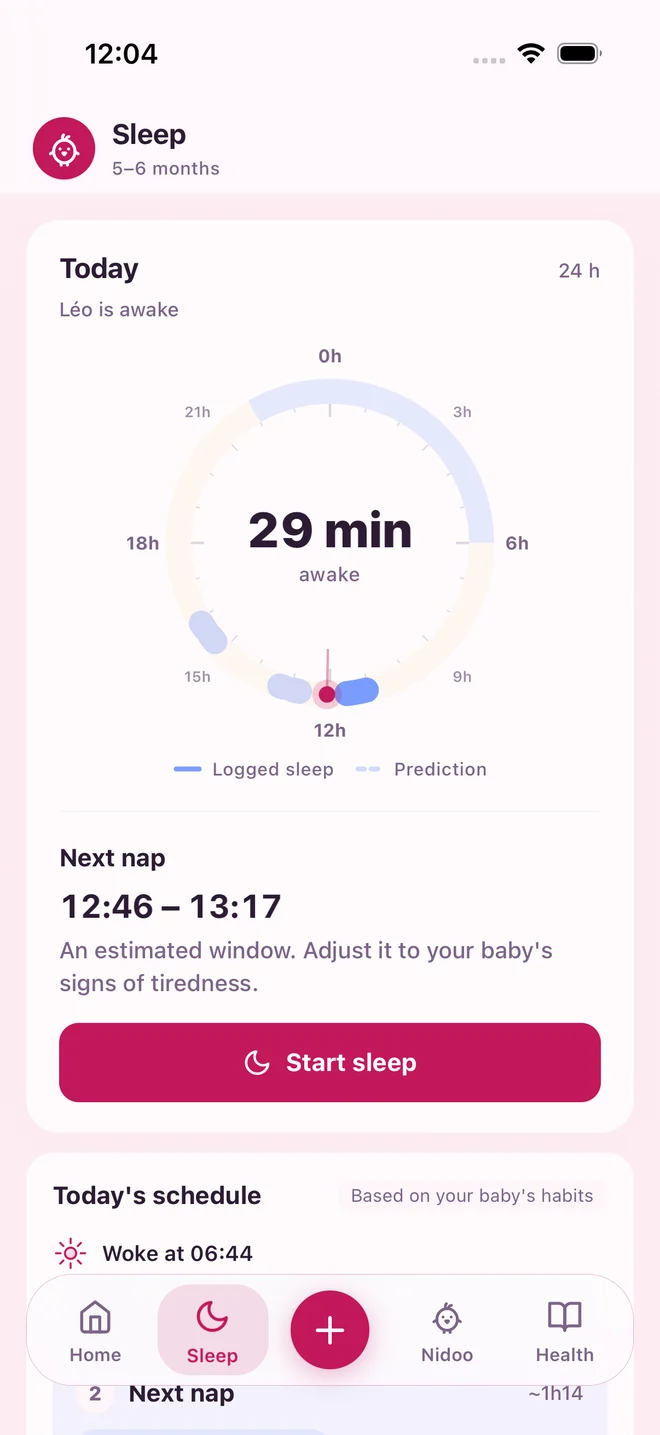
The next nap, estimated from what you log.
Start a sleep timer with a tap and see the day on a 24-hour clock. PetitNid then suggests a window for the next nap, to adjust to your baby’s signs of tiredness.
Sleep tracking is free. Nap estimates are part of Premium.
Explore sleep tracking

Sources checked
Consulted when writing and reviewing this guide. French sources are identified by their original organisation names.
- AFPA (mpedia.fr) — Helping your baby sleep at night
- Naître et grandir — Baby sleep
- WHO — Physical activity, sedentary behaviour and sleep under five
- Naître et grandir — Sleep between 5 and 17 months: Quebec study (2025)
- Assurance Maladie (ameli.fr) — Sleep difficulties in children
- Naître et grandir — Night waking from 1 to 3 years
- Assurance Maladie (ameli.fr) — Bronchiolitis: what to do
You don’t have to remember everything.
Download PetitNid to log your baby’s naps, nights and wake-ups. Sleep tracking is free for two parents; nap estimates are part of Premium.