
Baby milk amounts by age and weight
Milk amount references from birth to twelve months, the limits of the Appert calculation, and feeding cues to discuss with your baby’s doctor.

In the first month, AFPA gives an average of 6–8 bottles of 60–90 ml for a healthy, full-term formula-fed baby. By three to four months, its reference is five bottles of 150–180 ml. No single amount fits every baby of the same age.
Average milk amounts by age
These French AFPA references are starting points for discussion, not millilitre-by-millilitre feeding instructions.
| Age | Bottles over 24 hours | Amount per bottle | Daily reference total |
|---|---|---|---|
| Birth to 1 month | 6–8 | 60–90 ml | 420–720 ml |
| 1–2 months | 5–7 | 90–120 ml | 540–840 ml |
| 2–3 months | 5–6 | 120–150 ml | 600–900 ml |
| 3–4 months | 5 | 150–180 ml | 750–900 ml |
| 4–6 months | 4–5 | 180 ml | 720–1,000 ml |
| 6–12 months | 3–4 | Depends on complementary foods | About 500–800 ml of milk or dairy equivalents |
The 24-hour totals are the ranges AFPA publishes separately; they are not exact multiplication of the other columns. After six months, the total includes milk and dairy equivalents such as yoghurt or cheese.
Bottle size tends to increase while frequency decreases. Individual feeding plans may differ, especially with prematurity, illness, growth concerns or mixed feeding. For breastfeeding frequency, see how many breastfeeds a day.
Prepare formula using the exact water-to-powder ratio and scoop supplied for that product. One level scoop per 30 ml of water is common in French instructions but is not universal. Never add powder or water to change the concentration. Discuss changes in the amount offered with your baby’s professional when uncertain.
French preparation and storage guidance gives limits such as one hour at room temperature for a prepared bottle and half an hour after warming; leftovers from a started bottle are discarded. These limits have conditions and may differ from local recommendations elsewhere. See storing milk and water for formula, and follow local health advice and the product instructions.
The Appert rule: a rough weight-based reference
The Appert rule is a formula used in French feeding guidance to estimate an average daily milk amount:
Weight in grams ÷ 10 + 200–250 ml = a rough amount over 24 hours.
For a baby weighing 4,000 g, the arithmetic is 4,000 ÷ 10 = 400, then 400 + 200–250 = 600–650 ml per day. At 5 kg, it gives 700–750 ml. Dividing by a number of bottles gives an arithmetic per-bottle amount, not a prescription.
Our milk amount calculator displays the weight-based result alongside an age-based reference. Agreement between two estimates does not prove that either is right for your baby; disagreement is not a diagnosis.
AFPA presents this rule in its birth-to-four-month guidance, when milk is the only food. The relevant condition is that milk remains the sole food, not simply that a child is under six months. The calculator’s age limit does not make the rule suitable once complementary feeding has begun.
The calculation does not account for health, appetite, growth or how effectively a baby feeds. Use it as context for a conversation, not as a reason to force intake or delay seeking advice.
Milk after six months
French guidance recommends starting complementary foods between four and six months, with individual advice. WHO recommends exclusive breastfeeding for six months before adding complementary foods. When to start solids explains these recommendations in context.
AFPA describes milk as the main food until one year and gives about 500–800 ml of milk or dairy equivalents daily at 6–12 months. For breastfeeding, continue responsively. WHO recommends breastfeeding to two years or beyond alongside complementary foods, and notes that breast milk can supply half or more of energy needs at 6–12 months.
A change to follow-on formula should be discussed with the professional following your baby and must respect the product’s age instructions. Starting a few spoonfuls of food at four months does not automatically mean switching formula then.
How to tell whether intake is adequate
The visible millilitres can feel reassuring, but a professional considers more than one bottle total.
For breastfed babies, AFPA describes 5–6 heavily wet nappies per day from day four or five as a reassuring sign of effective feeding. This is not a diagnostic cutoff and should not be applied as a universal rule to every situation.
Growth is interpreted over time alongside examination and feeding history. A baby can be healthy on a lower percentile; the position alone does not establish adequate intake. See understanding growth charts.
Alertness and comfort when awake also matter. Unusual drowsiness, difficulty waking, reduced responsiveness or very poor intake need immediate medical attention rather than reassurance from a chart.
Respect appetite from feed to feed
Appetite can vary. Offer milk in response to early hunger cues such as mouth movements, sucking or hands moving towards the mouth, without waiting for crying.
If your baby slows down or turns away, allow a pause and do not force the remaining milk. Persistent refusal, illness symptoms or concerns about growth deserve advice. A low total should not be dismissed simply because variation can occur.
A shared record may help explain what was offered and taken: sharing breast and bottle feeding records. Periods of more frequent feeding are sometimes called growth spurts, but that label does not establish the cause or guarantee a quick return to the previous pattern.
When to contact your baby’s doctor
Ask promptly about weight loss, a clear slowing of growth, persistent feeding difficulty, pain or doubts about intake. There is no need to wait weeks for a concern to become more serious.
In an expert answer, AFPA describes regaining birth weight by around ten days; ask for advice if your baby has not done so.
Seek immediate medical advice if your baby is unusually sleepy, hard to wake, less responsive or passing very little urine. If they are less responsive or seem seriously unwell, call emergency services: 15 or 112 in France, or your local emergency number elsewhere.
PetitNid is not a medical device. If you are unsure, speak to your baby’s doctor.
Frequently asked questions
Can I calculate a milk amount from my baby’s weight?
The Appert rule gives a rough daily reference while milk is the sole food: weight in grams divided by ten, plus 200–250 ml. At 4 kg this gives 600–650 ml. It does not determine an individual feeding plan or prove that intake is adequate.
How much milk does a one-month-old drink?
For the one-to-two-month age band, AFPA gives averages of 5–7 bottles of 90–120 ml and a separate daily reference of 540–840 ml for healthy, full-term babies. Appetite and individual advice matter; these are not amounts to force.
Should I worry if my baby leaves milk in the bottle?
Turning away or stopping can mean fullness or a need for a pause. Do not force the bottle to be finished. Persistent refusal, poor intake or growth concerns need medical advice. Seek medical advice immediately for unusual drowsiness, difficulty waking, reduced responsiveness or very little urine.
In the PetitNid app
Track feeds without counting in your head.
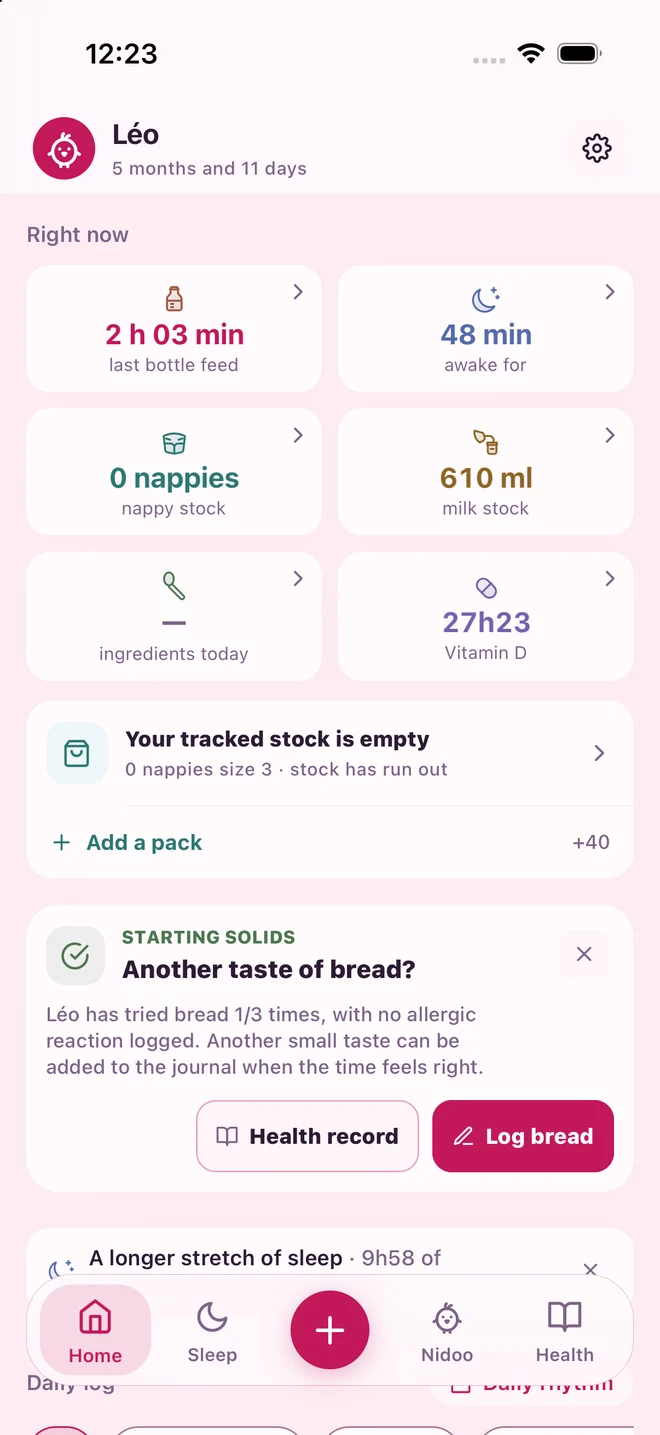
A timer tracks a breastfeed or bottle, with breast side and amount drunk. The home screen shows time since the last feed and how much milk is left in stock.
Breastfeeding and bottle tracking are free. Milk stock insights are part of Premium.
Explore breastfeeding and bottle tracking

Sources checked
Consulted when writing and reviewing this guide. French sources are identified by their original organisation names.
- AFPA (mpedia.fr) — Milk amounts by age
- AFPA (mpedia.fr) — Milk feeding from birth to 4 months
- AFPA (mpedia.fr) — Milk in a baby’s diet
- AFPA (mpedia.fr) — When breastfeeding is difficult
- AFPA (mpedia.fr) — Weight loss in a breastfed baby: expert answer
- AFPA (mpedia.fr) — Growth spurts and breastfeeding: expert answer
- Assurance Maladie (ameli.fr) — Preparing a bottle
- France’s 1000 First Days — Milk feeding from birth to 4 months
- WHO — Infant and young child feeding
- Assurance Maladie (ameli.fr) — Dehydration: symptoms and urgent help
You don’t have to remember everything.
Download PetitNid to log breastfeeds, breast side and bottles. Feed tracking is free, and the other parent can see what you log.