
Understanding your baby’s growth charts
Understand percentiles, growth trends, head circumference and the French child health record, with changes to discuss with your baby’s doctor.

A consultation can leave you remembering one number: “the 15th percentile”. A growth chart gives that number context. The doctor looks at the pattern over time, the relationship between measurements and the clinical examination.
This guide describes the French child health record and references used in France. Other countries may use different charts and check-up schedules. Discuss your baby’s measurements with the professional who follows them.
What the French child health record contains
The carnet de santé includes separate reference charts for girls and boys, covering:
- detailed weight tracking during the first month;
- weight, length and head circumference up to three years;
- height, weight and body mass index through childhood and adolescence.
The professional records measurements at check-ups. The record can show a change that would be difficult to judge by appearance alone, but a plotted point still needs interpretation.
Percentiles and growth channels
A percentile expresses position within a reference population. At the 50th percentile, about half the reference children of the same age and sex are below the value and half above. At the 15th, about fifteen out of one hundred are below it.
Some charts use standard deviations, sometimes labelled SD or DS in French. AFPA describes the broad reference zone between −2 and +2 standard deviations. These are statistical positions, not a pass-or-fail boundary for health.
A “growth channel” describes the path a child follows across measurements. A baby can be healthy on a lower percentile. The doctor considers the pattern over time alongside other measurements, family context and examination. A higher percentile does not mean a baby is healthier.
A clear slowdown or unusual acceleration can be important. Ask about a marked change rather than trying to diagnose it from the line yourself.
The first weeks
Newborn weight has its own context. Fluid changes after birth contribute to early weight loss. AFPA describes weight commonly stabilising around day three or four and beginning to rise around day five or six.
The amount of loss is assessed individually by the maternity team, alongside feeding and the baby’s condition. Factors around birth can affect the measurement.
AFPA advises a medical appointment if birth weight has not been regained by around ten days. Ask earlier if feeding, wet nappies, alertness or any other symptom concerns you. A check-up around the second week is also part of the French schedule.
During the first month, particularly with breastfeeding, AFPA describes weekly weighing with a midwife or PMI service, preferably using the same scale. PMI is France’s maternal and child health service. Follow an individual plan if your baby needs closer follow-up.
For broad feeding references and their limits, see milk amounts by age and weight.
Head circumference
Head circumference is interpreted alongside its progression and the rest of your baby’s examination. A marked slowdown or unusual acceleration needs medical review. A regular line, by itself, does not establish that no assessment is needed regardless of its position.
Measurement technique matters too. The professional can check a surprising result and decide what it means in context.
Body mass index and adiposity rebound
Body mass index, or BMI, is weight in kilograms divided by height in metres squared. Children’s BMI is interpreted on age- and sex-specific charts rather than using adult thresholds.
AFPA describes BMI rising during infancy, falling during early childhood and then rising again. The later upward turn is called adiposity rebound. Its guidance places this normally after around six years; an earlier rebound, for example around three or four years, is something the doctor considers even if the child does not appear overweight.
This pattern is assessed clinically. It is not a reason to restrict a baby’s food based on a plotted number or a home calculation.
French charts and WHO charts
The French health record uses French reference charts, while many international tools use WHO Child Growth Standards. Their reference populations and construction differ, so the same measurement can fall at a different percentile on a different chart.
Use the same chart when following a trend and identify which reference an app displays. Do not compare percentile labels from different charts as though the numbers were interchangeable. The record maintained by your healthcare professional remains the place to discuss clinical interpretation.
When to ask for advice
Regular check-ups include measurements and review of growth, often alongside vaccination appointments in France. Between visits, ask about:
- a clear change in growth pattern, upward or downward;
- birth weight not regained by around ten days;
- growth that seems to slow markedly or accelerate unusually;
- a notable change in head-circumference pattern;
- reduced feeding, frequent vomiting or unusual tiredness;
- any number you cannot interpret and find worrying.
You do not have to wait for several measurements before raising a concern. A professional can explain the chart and decide whether anything needs checking.
PetitNid is not a medical device. If you are unsure, speak to your baby’s doctor.
Frequently asked questions
What does the 15th percentile mean?
For the measurement and reference population used, about fifteen out of one hundred children of the same age and sex are below that value and eighty-five above it. A lower percentile can be compatible with health; the doctor considers the trend, other measurements and examination.
Does changing percentile mean something is wrong?
A change can have different explanations, including illness or measurement variation. Ask the doctor about a clear change in the growth pattern, upward or downward, rather than waiting for repeated measurements to confirm it yourself.
Why do newborns lose weight at first?
Early weight loss partly reflects fluid changes after birth. AFPA describes weight tending to stabilise around day three or four and rise around day five or six. The maternity team interprets the amount and feeding situation individually.
Do I need to weigh my baby at home every week?
Follow the plan agreed with the professional caring for your baby. AFPA describes weekly professional weighing during the first month, particularly with breastfeeding, using the same scale where possible. Routine home weighing is not a substitute for that assessment.
In the PetitNid app
Vaccinations, visits and growth charts, in one place.
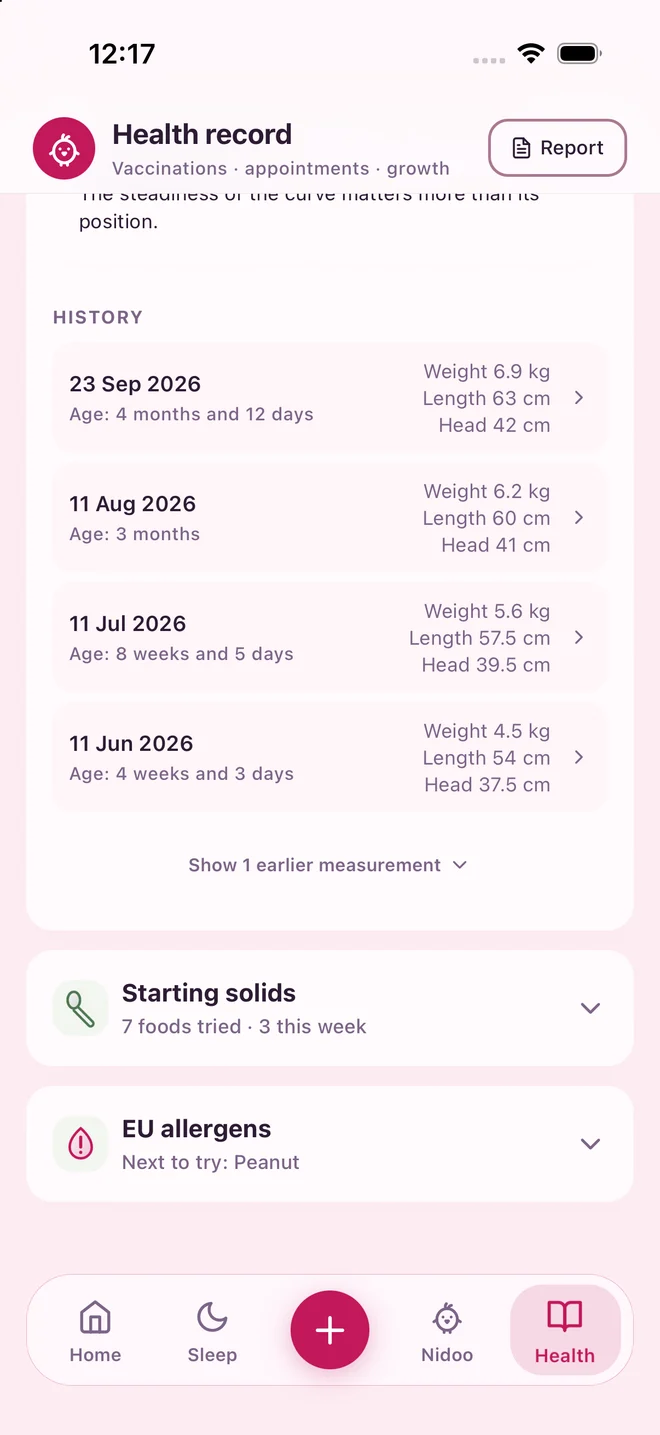
The record brings together vaccinations, visits and measurements plotted on WHO charts. You can create a PDF report before an appointment.
The full health record is part of Premium. It does not replace the official health record.
Explore the health record

Sources checked
Consulted when writing and reviewing this guide. French sources are identified by their original organisation names.
You don’t have to remember everything.
Download PetitNid to keep track of your baby’s day. Essential tracking is free; vaccinations, growth charts and PDF reports are part of Premium.