
Storing breast milk, prepared formula and formula powder
French guidance on storing expressed breast milk, prepared formula and opened powder, with temperature limits and differences between organisations.

“Can I still use this milk?” is a difficult question when you are tired and standing in front of the fridge. Clear labels and knowing which guidance you are following can help.
This guide describes French recommendations. If you live elsewhere, follow your local health authority’s guidance and the instructions on your formula packaging. Storage limits depend on temperature, hygiene and how the milk has been handled. Advice for premature or unwell babies may be different.
Storage references at a glance
| What you have | Storage conditions | Reference limit or advice |
|---|---|---|
| Prepared powdered formula | Room temperature | 1 hour |
| Prepared formula after warming | Room temperature | 30 minutes |
| A bottle your baby has started | Any storage location | Discard the remainder |
| Formula prepared in advance | Coldest part of fridge, at or below 4°C; not the door | Only exceptionally; prepare immediately before feeding whenever possible |
| Opened formula powder | Clean, cool, dry place; tightly closed | About 1 month; follow the packaging |
| Opened ready-to-feed liquid formula | Original container in refrigerator at 0–2°C | Up to 48 hours under the cited French guidance; follow the packaging |
| Freshly expressed breast milk, AFPA guidance | Room temperature, 19–22°C | 1 hour |
| Expressed breast milk | Refrigerator at or below 4°C | 48 hours |
| Expressed breast milk | Freezer at −18°C | 4 months |
| Thawed breast milk | Refrigerator | 24 hours; never refreeze |
| Warmed breast milk | Use after warming | 30 minutes |
| Opened bottled water for formula | Refrigerator | 24 hours |
The fresh breast-milk timings in the table are AFPA’s. Santé publique France gives different room-temperature guidance, described below. Do not combine the longest limit from one source with different temperature or handling conditions from another.
Powdered formula
Powdered formula is not sterile. Once mixed with water, it can support rapid microbial growth. ANSES and Assurance Maladie therefore recommend preparing it immediately before feeding where possible and using it within one hour at room temperature.
After warming, French guidance gives a half-hour limit for prepared powdered formula. Warmed ready-to-feed liquid formula is not kept for later. Once a baby has drunk from a bottle, discard the remainder rather than refrigerating it for the next feed.
French guidance specifies cold tap water meeting local quality requirements. The preparation method can differ elsewhere, including the water temperature used to prepare formula: follow your local health authority and product instructions, not an international assumption based on this French guide.
Use the scoop supplied with the current product and the exact ratio on its packaging. Scoops are not interchangeable. Keep the scoop level and dry; do not add extra powder or water to alter concentration.
For reference amounts, see milk amounts by age and weight. For frequency, see how many feeds a day.
Opened powder and liquid formula
French guidance gives about one month for opened powder stored tightly closed in a clean, cool, dry place. Check the manufacturer’s instructions, which govern the particular product. Keep its scoop dry and replace it with the tin rather than retaining it for another formula.
For opened sterile ready-to-feed formula, the cited French guidance gives a maximum of 48 hours in the original container at 0–2°C. Check which part of your fridge maintains that temperature; it is not necessarily the same shelf in every model. Follow the product’s storage instructions.
Expressed breast milk
AFPA gives the following limits for freshly collected milk: one hour at 19–22°C, 48 hours in a fridge at 4°C or below, and four months in a freezer at −18°C.
Santé publique France’s 2023 breastfeeding guide gives a maximum of four hours at 20–25 °C for freshly expressed milk, counted from the start of collection until your baby finishes drinking it. The difference is between organisations as well as between countries. For your situation, choose the guidance recommended by the professional supporting you and keep its temperature and handling conditions together.
The sources also differ on freezing:
- Santé publique France advises freezing milk immediately if it is intended for freezing, without an initial stay in the refrigerator.
- AFPA advises cooling it in the refrigerator for at least two hours and freezing it within 24 hours.
These are two different approaches to freezing milk. If you are uncertain which to follow, ask your midwife, lactation professional or baby’s doctor.
AFPA also describes practical storage precautions:
- Freeze small portions, for example around 60 ml, to reduce the amount left over.
- Leave space for expansion; fill containers only about three-quarters full.
- Do not mix milk at different temperatures. Collections from the same day can be combined after cooling to the same refrigerator temperature.
- Do not add newly expressed milk, even when cooled, to milk that is already frozen.
- Label each container with the date and time.
In the cited guidance, thawed milk can be kept for 24 hours in the refrigerator or one hour at room temperature, and must never be refrozen. Warmed milk should be used within half an hour. These limits are not extra periods to add successively to extend storage.
Use a warm-water bath, bottle warmer or warm running water to warm milk; do not microwave it. Microwaves can heat unevenly and cause burns. Check the temperature before feeding by placing a few drops on the inside of your forearm.
For expressing at work, AFPA describes refrigerating the milk and transporting it in an insulated bag or cool box with a cooling pack, at no more than 15°C, maintaining the cold chain. Ask for a plan suited to your journey and the storage available.
Why online advice differs
Storage advice can differ between organisations, even within France, and depends on temperature and how the milk has been handled. The fresh-milk timings here are those published by AFPA; its room-temperature and freezing advice differs from Santé publique France’s guide.
Check the source, the publication, the temperature and whether the advice concerns fresh, thawed, warmed or already-used milk. A longer time found online is not automatically applicable to the bottle in front of you.
Sharing what is in the fridge
A shared record can note when milk was expressed, where it is stored and which bottle has already been used. The label on the actual container remains important. Sharing feeding records suggests a simple handover format.
When to ask for individual advice
Ask your baby’s doctor, midwife or lactation professional about prematurity, low birth weight, illness, donating to a milk bank, uncertain refrigeration or any doubt about whether stored milk is suitable. The general references here do not replace the instructions given for a specific medical situation.
PetitNid is not a medical device. If you are unsure, speak to your baby’s doctor.
Frequently asked questions
Can prepared formula be kept in the fridge?
ANSES reserves advance preparation for exceptional circumstances, in the coldest part of a refrigerator at 4°C or below, never the door. Prepare immediately before feeding whenever possible. This guide does not give an unrestricted storage period for advance preparation; follow local and product guidance.
Can I save milk left in a bottle my baby has used?
French guidance says to discard the remaining milk rather than save it for another feed, including in the refrigerator.
How long can expressed breast milk be stored?
AFPA gives one hour at 19–22°C, 48 hours at 4°C or below, and four months at −18°C. Its advice differs from Santé publique France on room-temperature storage and freezing. Thawed milk is kept for up to 24 hours in the refrigerator and must not be refrozen.
How long does an opened tin of formula last?
French guidance gives about one month, tightly closed in a clean, cool, dry place. Follow your product’s instructions if they specify a different period. Keep the supplied scoop dry and do not substitute another brand’s scoop.
In the PetitNid app
Track feeds without counting in your head.
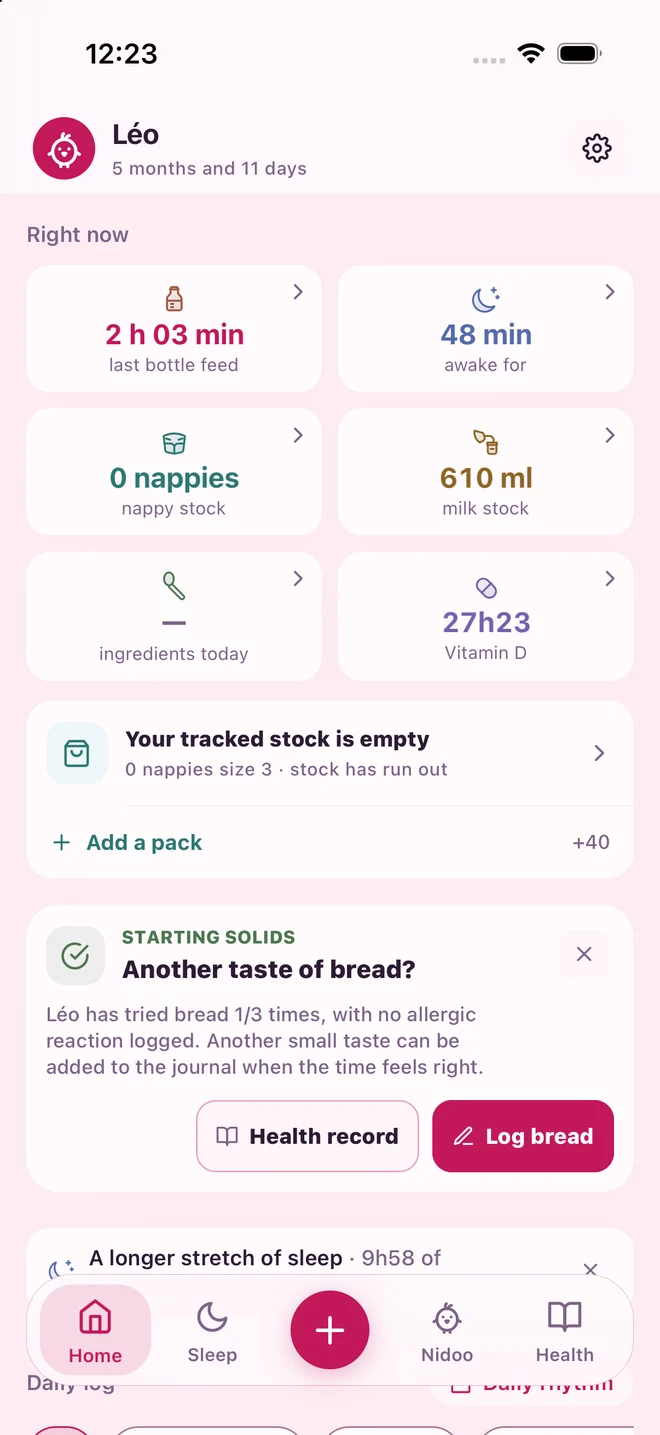
A timer tracks a breastfeed or bottle, with breast side and amount drunk. The home screen shows time since the last feed and how much milk is left in stock.
Breastfeeding and bottle tracking are free. Milk stock insights are part of Premium.
Explore breastfeeding and bottle tracking

Sources checked
Consulted when writing and reviewing this guide. French sources are identified by their original organisation names.
You don’t have to remember everything.
Download PetitNid to log breastfeeds, breast side and bottles. Feed tracking is free, and the other parent can see what you log.