
When and how to start solid foods
French guidance on starting complementary foods between four and six months, with readiness cues, first foods, textures and allergen precautions.

Complementary feeding means adding foods alongside breast milk or formula. It brings new tastes, textures and ways of eating, and often plenty of conflicting advice from people around you.
This guide follows French recommendations. If you live elsewhere, check the local guidance with the healthcare professional who follows your baby. French guidance places the start between four and six completed months, never before four months. WHO recommends exclusive breastfeeding for six months, then complementary foods alongside continued breastfeeding. These recommendations have different framing; discuss your baby’s situation rather than treating one age as a universal instruction.
How can you tell whether your baby is ready?
Age gives the recommended window; development helps determine what is appropriate within it. Relevant observations include head control, a supported feeding posture, interest in food and opening the mouth when a spoon is offered.
If your baby is within the recommended age window and has the head control and supported posture needed for feeding, you can discuss starting with small spoonfuls with their healthcare professional. Interest in your plate alone does not mean a younger baby is ready.
Do not force food into a closed mouth. If your baby turns away or strongly rejects the spoon, pause and discuss how to proceed if this continues. Prematurity or developmental and medical concerns need individual advice.
Which foods can come first?
PNNS, France’s national nutrition programme, and Assurance Maladie do not require a particular order between vegetables, fruit, meat, fish, eggs, pulses, starchy foods and suitable dairy foods. This does not mean offering every food at once.
Smooth cooked vegetable purées are a familiar starting point: carrot, courgette, green beans, parsnip or squash, cooked without salt and blended to a suitable texture. Fruit can be offered without added sugar, such as cooked apple or pear, or appropriately prepared ripe fruit. Beginning with vegetables is a common habit rather than an obligatory sequence.
The PNNS guide includes small amounts of thoroughly cooked meat, fish or egg during the first weeks, for example a teaspoon. These foods contribute nutrients including iron. Observe allergy precautions and use a texture your baby can manage.
Offer individual flavours initially, then combine familiar foods. Vary foods over time, without adding salt or sugar. Add a little fat from the start, varying oils and using butter occasionally, with age-appropriate amounts discussed with your healthcare professional.
Choose a calm moment when your baby is alert. A food diary can help record what was offered and any symptoms; it does not need to become a rigid introduction timetable.
Milk continues alongside food. AFPA describes it as the main food until one year, while WHO recommends continued breastfeeding to two years or beyond with complementary foods.
Age and texture references
French sources differ in the ages they give for texture progression. Keep those attributions visible rather than merging them into one rule.
| Stage | Texture or approach | Amount context |
|---|---|---|
| Starting within the French 4–6-month window | Very smooth foods, small spoonfuls | Increase gradually with appetite |
| 6–8 months | PNNS allows gradual new textures from around 6–8 months, depending on when feeding began | A small serving of vegetables, increasing with appetite |
| 8–10 months | ANSES recommends moving to non-smooth textures between 8 and 10 months; Ameli describes mashed or less finely blended foods | Adapt portions and texture to the child |
| 10–12 months | Ameli introduces small soft pieces from 10 months | Adapted family foods, under constant supervision |
AFPA describes first soft pieces around eight to nine months. This is separate from the earlier PNNS reference to gradually changing texture: it should not be read as permission to give pieces before your baby can manage them.
French PNNS guidance gives about 10 g of cooked meat or fish daily, or a quarter of a hard-boiled egg, from six to twelve months. These are reference amounts of food, not grams of pure protein and not a target to finish.
WHO describes two to three complementary meals daily at six to eight months and three to four at nine to twenty-three months, alongside milk. See food by age for illustrative meals. Portions and frequency need individual context rather than being a scorecard.
Introducing food allergens
If your baby has severe eczema, a known food allergy or a previous reaction, ask their doctor or allergy specialist before introducing the relevant foods. A family history of allergy can also be discussed as part of the plan.
French recommendations advise introducing the main food allergens without delay once complementary feeding has started, including for babies with a family history of allergy. This is not a promise to prevent every allergy. ANSES highlights dairy foods, egg and peanut among the main allergens.
Offer one new allergen at a time in a small, age-appropriate form, at a time when you can observe your baby afterwards. Once a food is tolerated, continue offering it regularly as advised. A known allergy requires a medical plan, not a home reintroduction based on general guidance.
The EU’s list of 14 allergen categories is a food-labelling list, not a checklist of everything to introduce to a baby. Some listed foods or forms are unsuitable: French ANSES and PNNS guidance advises against soy products before three years, for example.
See introducing allergens for forms, precautions and symptoms that need urgent help.
Progress without forcing
A grimace or initial refusal does not necessarily mean a food will never be accepted. ANSES discusses offering an initially refused food eight to ten times; PNNS says acceptance can sometimes take up to ten offers. These are opportunities, not repeated attempts in one sitting or a requirement to finish.
Keep offering varied foods calmly and respect refusal. Persistent feeding difficulty, poor intake or growth concerns deserve professional advice rather than an assumption that they are just a phase.
Plain water is the drink to offer alongside milk once complementary feeding begins, without added sugar or juice. Water for your baby explains the French guidance and its international limits.
After an interruption, return to a manageable routine and continue foods already tolerated. A dated record can help you remember previous introductions and any medical advice.
Baby-led weaning and finger foods
Baby-led weaning usually describes a baby picking up appropriately prepared foods themselves rather than relying only on spoon-fed purées. Social media can make it seem like a required next step, but you can discuss different approaches without abandoning spoon feeding.
In its 2025 discussion, AFPA does not recommend baby-led weaning as an alternative to traditional complementary feeding. It raises concerns about energy and iron intake and choking. This is an attributed position in that discussion, not a claim that all research or all countries use identical advice.
The French PNNS brochure describes supervised exploration from around six months when the baby sits well and can grasp food and bring it to the mouth. All eating requires an adult’s constant supervision and appropriate posture, preparation and texture.
Spoon feeding does not prevent exploration with the hands. Ask a qualified professional which foods and textures suit your child and how to reduce choking risk. If offering bread as described in the PNNS guidance, replace it once soaked with saliva because a piece may break off, and supervise throughout. Sweet biscuits are not a necessary stage.
Foods and forms to avoid or limit
| Food or form | French guidance | Reason |
|---|---|---|
| Honey | No honey before 12 months | Infant botulism risk |
| Added salt or sugar | Delay and limit | Avoid excessive salt and encourage discovery of flavours |
| Cow’s milk as the main drink | Not before 12 months | Does not match infant feeding needs |
| Whole nuts or whole grapes | Avoid in young children; the cited guidance uses five years | Choking risk |
| Hard raw vegetable pieces | Do not offer in a hard form to a baby; adapt preparation and texture | Choking risk |
| Raw or undercooked meat, fish, shellfish or eggs | Avoid in young children; ANSES lists children aged 0–5 years | Infection risk |
| Raw milk and raw-milk cheese | Avoid in young children, except cooked pressed cheeses such as Gruyère or Comté | Infection risk |
| Tuna | Limit according to French guidance | Mercury exposure |
| Swordfish, marlin and shark | Avoid for young children in the cited guidance | Mercury exposure |
Follow food-safety advice as well as adapting texture: some foods remain unsuitable even when soft. Milk continues alongside foods; feeding frequency explains how to keep that in view.
PetitNid is not a medical device. If you are unsure, speak to your baby’s doctor.
Frequently asked questions
At what age can complementary feeding begin?
French recommendations use a window between four and six completed months, never before four months. WHO recommends exclusive breastfeeding for six months before complementary foods. Discuss your baby’s development and local guidance with their healthcare professional.
Should vegetables or fruit come first?
French PNNS and Assurance Maladie guidance does not require a particular order between food groups. Start with small amounts and suitable textures, without added salt or sugar. Offering individual flavours initially can make foods easier to identify.
Can meat, fish or egg be offered early?
The French PNNS guide includes very small amounts of thoroughly cooked meat, fish or egg in the first weeks of complementary feeding, for example a teaspoon. Follow age-appropriate advice and texture, and seek individual advice for allergy concerns.
What about baby-led weaning?
The French PNNS brochure describes supervised exploration from around six months when the baby can sit well and grasp food. AFPA’s 2025 discussion does not recommend baby-led weaning as a replacement for traditional complementary feeding, citing concerns including iron intake and choking. Discuss the approach and safe textures with a qualified professional.
In the PetitNid app
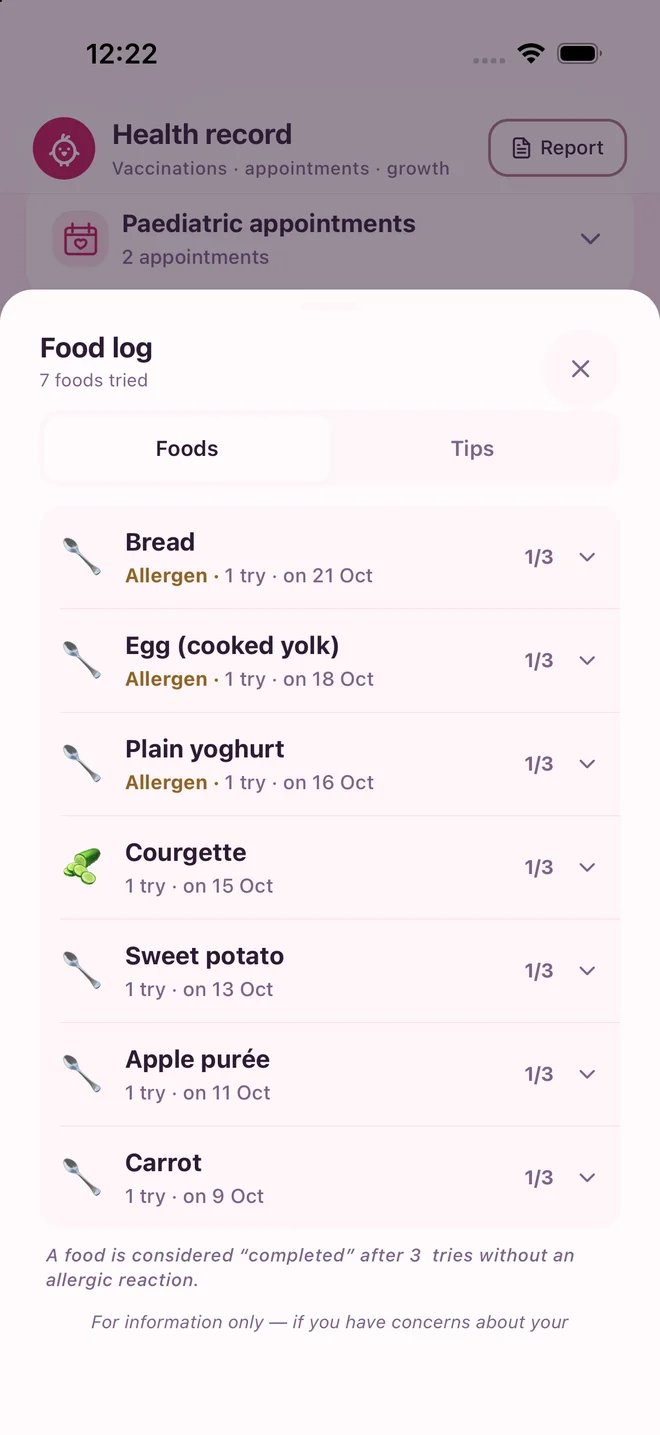
Foods tried and 14 allergens, in one diary.
Log each new food with any reaction observed. The diary keeps foods your baby has tried and tracks the EU’s 14 food labelling allergens. This tracking list is not a recommendation to introduce every item.
Logging a meal stays free. The food and allergen diary is part of Premium.
Explore the food diary

Sources checked
Consulted when writing and reviewing this guide. French sources are identified by their original organisation names.
- Santé publique France — PNNS complementary-feeding reference chart
- France’s 1000 First Days — Starting solid foods between 4 and 6 months
- WHO — Infant and young child feeding
- AFPA (mpedia.fr) — Complementary feeding
- AFPA (mpedia.fr) — Baby-led weaning: AFPA discussion (2025)
- Santé publique France — French PNNS guide to complementary feeding
- Assurance Maladie (ameli.fr) — Starting complementary feeding
- ANSES — Nutrition guidance for children aged 0–3 (2019)
- AFPA (mpedia.fr) — Introducing food allergens: expert answer
- Assurance Maladie (ameli.fr) — Food allergy: symptoms and emergencies
- ANSES — Food allergies: ANSES assessment (2018)
You don’t have to remember everything.
Download PetitNid to keep your baby’s meals in their journal. Meal tracking is free; the food and allergen diary is part of Premium.