
Sharing breastfeeding and bottle-feeding records
Useful notes for sharing feeding care, ways the other parent can help, and what to compare when choosing a shared breastfeeding or bottle diary.

At three in the morning, it can be difficult to remember when the last feed began. A shared record gives the next caregiver information without requiring a full retelling of the night. Paper, a message or an app can all serve that purpose.
What helps at a handover
The next parent may need a simple update: when the feed started, which breast or bottle, an approximate duration or amount, and whether a nappy was changed. That is an example of useful handover information, not a medically complete record for every baby.
The French 1000 First Days guidance describes the other parent’s support through presence and attention to the breastfeeding parent’s needs and choices. Practical help may include bringing the baby for a feed, changing nappies or settling them afterwards.
Four notes to start with
For everyday organisation, you can begin with:
- Start time. This helps the next parent understand what happened. It does not predict when the next feed must occur; offer it in response to your baby’s cues.
- Breast or bottle. If useful, note the side last offered. This may help you remember what to offer next.
- Approximate duration or amount. Label estimates as estimates. Duration does not measure breast-milk intake.
- Wet and dirty nappies. These are observations to consider alongside feeding, growth and alertness.
Add context when useful, such as illness or a change in care. If a health professional has asked you to keep a record, follow their instructions about details and timing.
AFPA gives examples of whole breastfeeds lasting around five minutes or 30–40 minutes. A timer therefore records an event; it does not assess feeding quality or tell you how much milk was transferred.
How the other parent can help
WHO recommends exclusive breastfeeding for the first six months, then complementary foods alongside continued breastfeeding. Supporting breastfeeding involves much more than giving a bottle.
The other parent can:
- bring the baby for a feed and help with nappies or settling;
- make useful notes when the feeding parent’s hands are occupied;
- offer practical help, food and water;
- spend time carrying, cuddling, bathing, talking and playing with the baby.
If your family chooses expressed-milk bottles, discuss the timing and practical plan with the professional supporting you. See milk storage for French storage references and their conditions.
When possible, AFPA suggests waiting around six weeks before introducing the first bottle so breastfeeding can become established. This is general advice, not a restriction that overrides medical needs. For mixed feeding, AFPA suggests replacing feeds gradually, often beginning with a less abundant afternoon feed and allowing time before replacing another. A midwife or lactation professional can adapt this to your situation.
Paper, messages or an app
| Method | What may be useful | What to consider |
|---|---|---|
| A paper notebook | Familiar, no battery or connection needed | The person away from home cannot see it immediately |
| Messages between caregivers | Uses a tool you may already share | Finding a past feed can require searching the conversation |
| A shared tracking app | A structured record, history and possibly shared timers | Requires setup; sharing and offline behaviour differ by product |
Choose a format the people caring for your baby can access. Paper may suit you well; remote access can become more useful after returning to work or starting childcare.
Comparing sharing features
Our baby tracking app comparison gives a dated overview with links to publishers’ public information. It covers the French market; prices and availability can differ elsewhere. It is published by PetitNid, and a feature not established publicly is not automatically absent.
Check the current details for the apps you are considering rather than relying on a product name or an old price. PetitNid offers shared records on iOS and Android, running timers, family roles and offline recording that synchronises later. Its journal currently supports one baby and up to two parents. Version 1.2.0 adds English alongside French.
Five questions before choosing an app
- How quickly do new entries appear on the other phone when connected?
- Does sharing work across the devices you actually use?
- Can both parents see a running feed timer?
- Which actions work offline, and when do they synchronise?
- How many caregiver accounts are included?
If you want access for a childminder or grandparents, check the account limit specifically. Do not assume a product designed for two parents includes an unlimited care team.
Age references for reading the record
| Age | Breastfeeding pattern described by AFPA | How to use a record |
|---|---|---|
| First month | Commonly 8–12 feeds over 24 hours, responsively | Note events that help with care or professional follow-up |
| 1–3 months | Feeds may become slightly less frequent, unless already at six or fewer daily; the longest gap may lengthen | Record the pattern without imposing intervals |
| After 3 months while exclusively breastfeeding | Relatively little change in frequency | Review the record when it helps you |
| With complementary feeding | Foods are added alongside milk | Note newly offered foods if useful |
See breastfeeding frequency and milk amounts for fuller context. Sleep tracking apps applies similar sharing questions to nights and naps.
Keep the record useful
Agree on one place for the information. Let the person with a free hand make the entry when practical. Decide how much detail helps, and review that decision if recording becomes stressful.
An incomplete record can still describe particular events, but it cannot prove total intake. There is no fixed period here that makes occasional tracking equivalent to a diary requested by a clinician. Follow professional instructions when applicable.
Bring relevant observations to appointments. They can help explain what you noticed without requiring exact recall in the waiting room.
When to seek support
Ask about painful breastfeeding, engorgement, a clear change in growth, noticeably fewer wet nappies or concerns about intake. AFPA describes 5–6 heavily wet nappies from day four or five in a breastfed baby feeding well; this is a reassuring sign, not a universal diagnostic cutoff.
Seek medical advice immediately for unusual drowsiness, difficulty waking, reduced responsiveness or very little urine. For signs of severe dehydration or altered consciousness, call emergency services: 15 or 112 in France, or your local emergency number elsewhere.
Your exhaustion also deserves support. HAS, France’s health authority, emphasises help from professionals trained in breastfeeding. You can ask early rather than waiting until the situation feels unmanageable.
PetitNid is not a medical device. If you are unsure, speak to your baby’s doctor.
Frequently asked questions
What should I look for in a shared feeding app?
Check that both phones can access the same information, including a running timer, and whether sharing works across iOS and Android. Check offline behaviour and the number of caregiver accounts. PetitNid shares one baby’s journal between up to two parents, with French and English from version 1.2.0.
How can the other parent help during breastfeeding?
They can bring the baby for a feed, change nappies, help settle them afterwards, keep useful notes and offer practical support. France’s 1000 First Days guidance emphasises presence and attention to the breastfeeding parent’s needs and choices.
Do we need to record every feed?
For everyday organisation, choose a level of detail that helps you. A missing entry makes the record incomplete, so do not treat it as a complete measure of intake. If a professional has requested a feeding diary, follow their instructions.
When can we introduce a bottle?
When possible, AFPA suggests waiting around six weeks before introducing the first bottle, to allow breastfeeding to become established. Your midwife or doctor can help decide what suits your situation; general timing must not delay a feed or supplement that is medically needed.
In the PetitNid app
Track feeds without counting in your head.
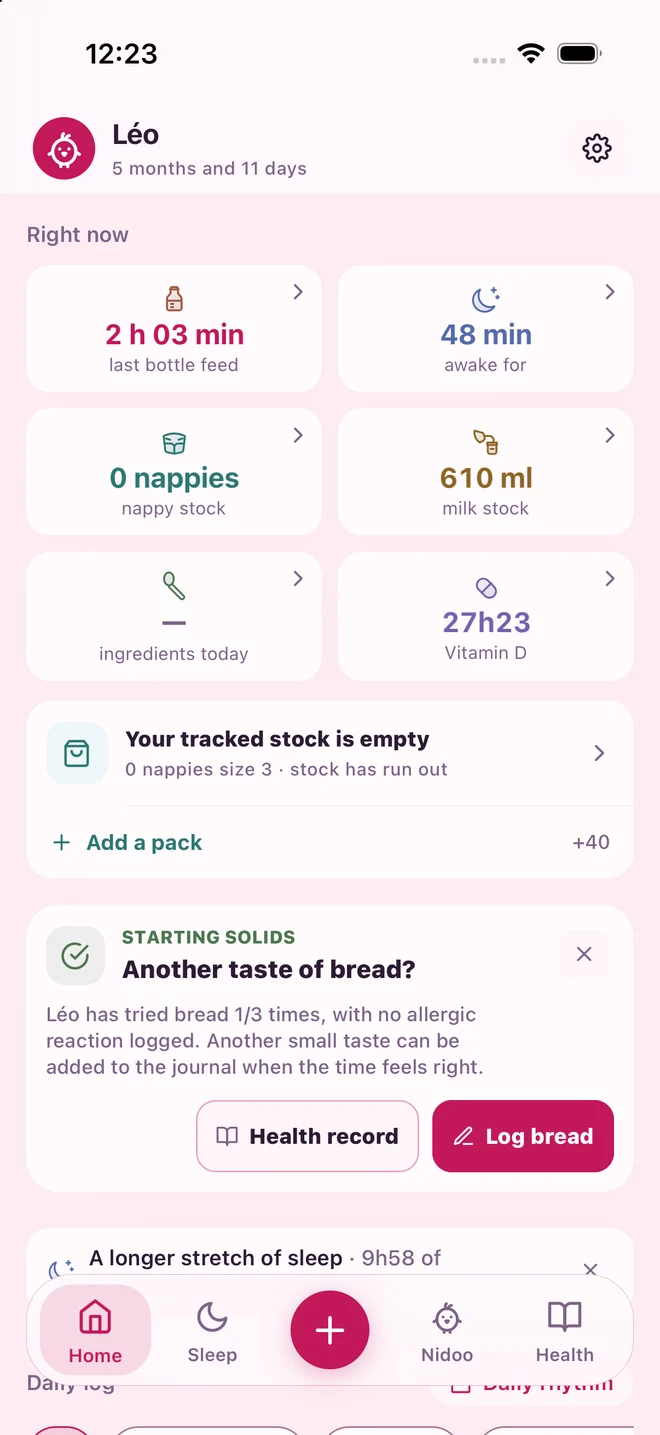
A timer tracks a breastfeed or bottle, with breast side and amount drunk. The home screen shows time since the last feed and how much milk is left in stock.
Breastfeeding and bottle tracking are free. Milk stock insights are part of Premium.
Explore breastfeeding and bottle tracking

Sources checked
Consulted when writing and reviewing this guide. French sources are identified by their original organisation names.
- AFPA (mpedia.fr) — Breastfeeding frequency and duration
- AFPA (mpedia.fr) — Combining breast and bottle feeding
- AFPA (mpedia.fr) — When breastfeeding is difficult
- France’s 1000 First Days — Breastfeeding support
- HAS — Breastfeeding in the first six months
- WHO — Infant and young child feeding
- Assurance Maladie (ameli.fr) — Dehydration: symptoms and urgent help
You don’t have to remember everything.
Download PetitNid to log breastfeeds, breast side and bottles. Feed tracking is free, and the other parent can see what you log.