
Which water should you use for baby formula?
French guidance on tap and bottled water for formula, reading water labels, using the correct dilution and cleaning feeding equipment.

Tap water, spring water or mineral water: the choice can seem confusing. The answer depends on local water quality and the preparation guidance where you live.
This guide describes French recommendations. If you live elsewhere, follow your local health authority’s guidance and the instructions on your formula packaging. Advice about water temperature and preparation is not the same everywhere. Powdered formula is not sterile.
Tap water: conditions in French guidance
ANSES and Assurance Maladie allow tap water meeting the required quality criteria, with precautions:
- Let it run for a few seconds before filling the bottle. If the tap has not been used for several hours, the cited guidance describes running it for one to two minutes.
- Use cold water. The French sources warn that tap water above 25°C may contain more microorganisms and minerals; a mixer tap in the middle position is not reliably cold.
- Do not use household-filtered or softened water. ANSES, Assurance Maladie and AFPA advise against these systems for formula preparation, including because of microbial growth concerns.
- Clean and descale the tap aerator regularly. The French guidance describes removing it, using white vinegar and rinsing it thoroughly.
- Consider old lead pipes. In France, buildings dating from before 1948 may still contain them. This date is a French housing reference, not a worldwide cutoff.
In France, the local council or regional health agency can provide information about the distribution network. If water quality in your home is uncertain, seek advice and use an appropriate alternative while the issue is checked.
Bottled water: read the actual label
French guidance uses the wording “convient pour la préparation des aliments pour nourrissons”, meaning suitable for preparing infant food. Look for it on the bottle itself rather than relying on a familiar brand name.
AFPA also advises a dry residue at 180°C below 500 mg/L, indicating low mineral content. This threshold is attributed to AFPA; it is not presented as a universal international labelling rule.
ANSES and Assurance Maladie advise against sparkling water for bottles.
AFPA distinguishes natural mineral water, with a stable controlled composition, from spring water, whose composition can vary. A brand may use several springs. Bottled table water is another category. These names alone do not tell you whether a particular bottle is appropriate for an infant.
Once opened, close the bottle, refrigerate it and use it for formula within 24 hours under the cited French guidance.
Use the exact water-to-powder ratio
French guidance commonly describes one level scoop per 30 ml of water. Always use the scoop supplied with your formula and follow the exact water-to-powder ratio on its packaging; never change the dilution yourself.
Measure the water first, then add the powder. The powder adds volume, so measuring the finished mixture instead of the initial water gives a different result.
Use a level scoop, without packing or heaping it. Use the product’s levelling edge where provided, or the clean method described in its instructions; do not use a finger. Keep the scoop dry and do not substitute one from another product.
If you think the concentration needs changing, speak to your baby’s doctor. Do not add extra powder for a more filling feed or extra water to stretch the milk.
For broad amount references, see milk amounts by age and weight. For feeding patterns, see breastfeeds and bottles per day.
Boiling and warming: keep the country context
The French ANSES and Assurance Maladie sources cited here do not require boiling water that meets their criteria. They discuss boiled and cooled water when suitable drinking or bottled water is unavailable abroad.
Follow your local health authority’s instructions and the formula packaging, particularly the temperature at which powder should be mixed. If the two seem inconsistent, ask a qualified professional for clarification.
For warming a prepared bottle, French guidance describes a water bath or bottle warmer without exceeding 37°C. Do not microwave a bottle: uneven heating can cause burns. Shake the bottle well and check the temperature by placing a few drops on the inside of your wrist before feeding. The cited French sources also allow feeding at room temperature.
Cleaning bottles
French guidance describes taking bottles apart and washing them with hot water, washing-up liquid and a bottle brush, followed by thorough rinsing. ANSES gives a complete dishwasher cycle at at least 65°C with drying as an option; rubber teats are washed by hand.
The French sources do not require routine sterilisation in the ordinary home situation described. Other countries and individual medical situations may have different requirements. Follow local advice and the equipment instructions.
Allow cleaned parts to air-dry inverted, without drying them with a tea towel, then store them in a clean, dry place. Keep the formula scoop dry.
Water to drink outside milk feeds
For a healthy baby before complementary feeding, milk normally supplies water needs. During hot weather, AFPA’s French guidance advises offering the breast more frequently and discusses extra feeds and small amounts of water between formula feeds. Ask for age-appropriate advice in your setting; water must not replace needed milk or alter formula concentration.
Fever, vomiting, diarrhoea, markedly fewer wet nappies or dark urine need prompt medical advice. During heat-related warning signs, Santé publique France advises breast milk for a breastfed baby or oral rehydration solution while seeking help. Plain water is not the same as oral rehydration solution.
Call emergency services immediately if your baby is hard to wake, cannot or will not drink, has an unusual skin colour or seems seriously unwell. In France, call 15 or 112; elsewhere, use your local emergency number.
Once complementary feeding begins, plain water is the drink to offer alongside milk, without adding sugar or juice. See starting solid foods.
Going out and getting advice
For a short outing, the cited French guidance suggests carrying the water and measured powder separately and mixing immediately before feeding, following the applicable preparation method. Do not use this as a substitute for the temperature requirements in your own country.
See milk storage for timing and temperature conditions. Ask for individual advice for prematurity, low birth weight, illness or uncertainty about the water supply.
PetitNid is not a medical device. If you are unsure, speak to your baby’s doctor.
Frequently asked questions
Can tap water be used for formula?
French guidance allows tap water that meets the required quality criteria, with cold water, appropriate flushing and a maintained tap. It advises against household-filtered or softened water. These are French recommendations; elsewhere follow your local health authority’s preparation guidance.
Which bottled water is suitable in France?
Look for the wording “convient pour la préparation des aliments pour nourrissons”, meaning suitable for preparing infant food. AFPA also advises a dry residue at 180°C below 500 mg/L. Refrigerate an opened bottle and use it for formula within 24 hours under this guidance.
Does water for formula need boiling?
The French sources cited here do not require boiling water that meets their stated criteria. Preparation-temperature advice differs between countries. Follow your local health authority and the instructions for your formula; do not apply the French method as a universal rule.
Is every spring water suitable?
No. Under the French guidance described here, check the infant-food preparation wording on the actual bottle. Spring-water composition can differ, including between sources sold under a brand. The category or brand name alone does not establish suitability.
In the PetitNid app
Track feeds without counting in your head.
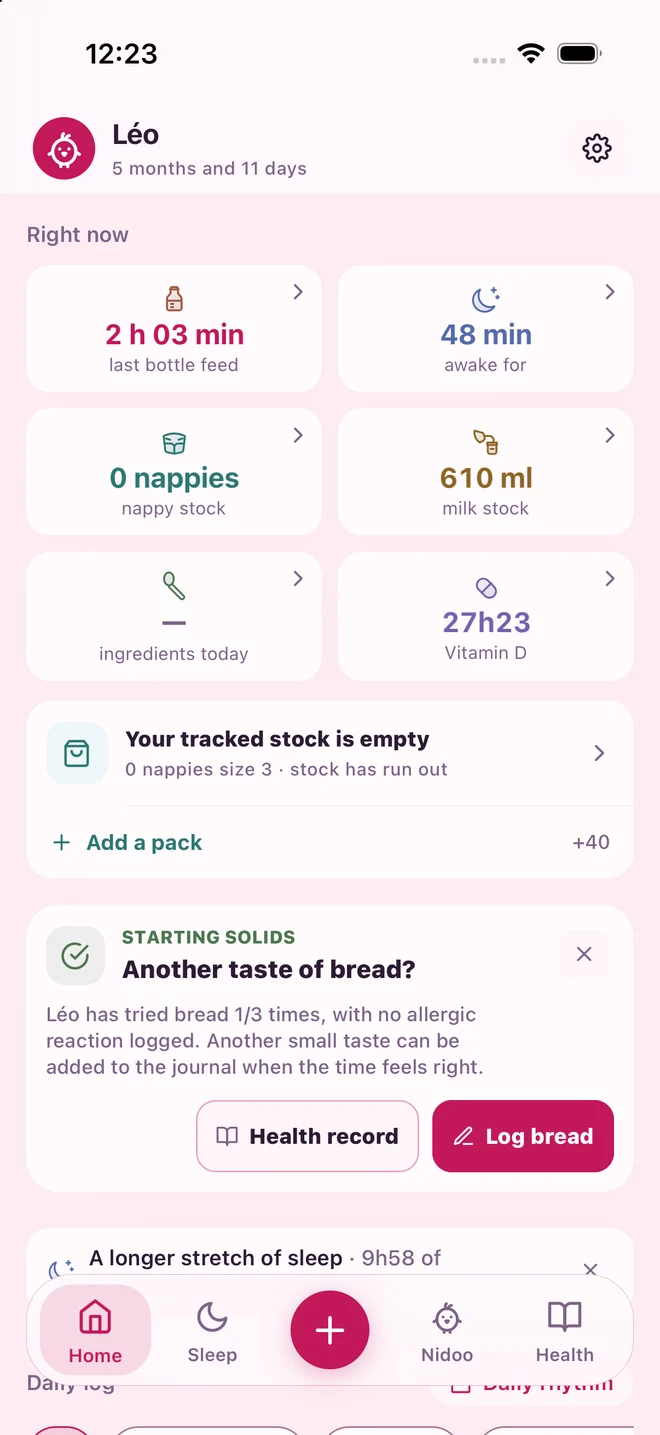
A timer tracks a breastfeed or bottle, with breast side and amount drunk. The home screen shows time since the last feed and how much milk is left in stock.
Breastfeeding and bottle tracking are free. Milk stock insights are part of Premium.
Explore breastfeeding and bottle tracking

Sources checked
Consulted when writing and reviewing this guide. French sources are identified by their original organisation names.
- ANSES — Preparing and storing formula
- AFPA (mpedia.fr) — Choosing water for formula
- AFPA (mpedia.fr) — Preparing formula
- AFPA (mpedia.fr) — Water for babies under six months
- Santé publique France — Protecting children in hot weather
- Assurance Maladie (ameli.fr) — Preparing a bottle
- France’s 1000 First Days — Drinking water
You don’t have to remember everything.
Download PetitNid to log breastfeeds, breast side and bottles. Feed tracking is free, and the other parent can see what you log.