
Baby food ideas by age, from first tastes to family meals
Illustrative meals based on French complementary-feeding guidance, with milk, textures, food amounts and safety precautions from four to twelve months.
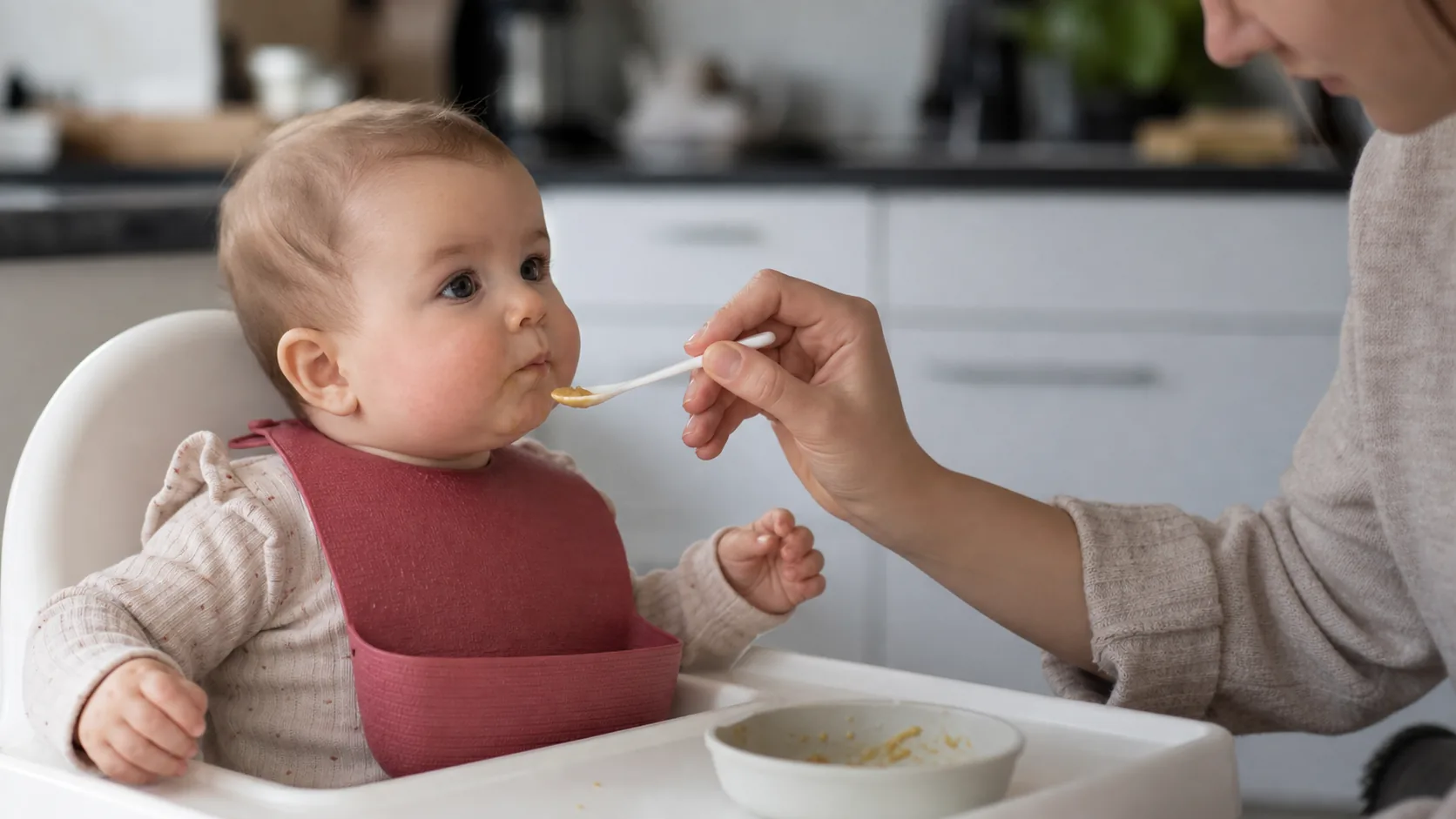
At the first spoonful, “Is this enough?” can become the main question. A menu can offer ideas, but it should not become a set of portions your baby must finish.
This guide follows French recommendations. If you live elsewhere, check local guidance with the professional following your baby. The examples below show possibilities from early tastes to adapted family meals. They are not individual meal plans.
Milk remains important
Complementary foods are added alongside milk. AFPA describes milk as the main food until one year. Keep breastfeeding responsively. For bottle feeds, amounts and frequency depend on your baby’s appetite and the advice of the professional who follows them.
AFPA gives around 500–800 ml of milk or dairy equivalents daily between six and twelve months. The 1000 First Days website describes milk remaining part of at least two meals in its four-meal example. This does not impose a four-feed limit on breastfeeding.
Our guide to breastfeeding and bottle frequency explains the distinction between reference patterns and a schedule to enforce.
Four to six months: first tastes
French guidance places the start within this age window, never before four months, with appropriate readiness and individual advice. See when to start solids.
You might offer a few small spoonfuls of a smooth cooked vegetable purée without salt, at a calm moment. Change vegetables over time and introduce individual flavours before more complex mixtures.
Fruit without added sugar can be offered from the start too; PNNS does not require a sequence of vegetables before fruit. Add a little fat to suitable foods, varying oils and using butter occasionally. Ask about age-appropriate amounts rather than applying one quantity to every stage.
This is also when French guidance advises introducing major allergens without unnecessary delay once complementary feeding has begun. For severe eczema, a known allergy or a previous reaction, seek medical advice first. See introducing allergens.
Six to eight months: an example day
A day might include:
- On waking: a breastfeed or bottle, according to need.
- At lunch: vegetables and a starchy food in an appropriate texture, with a little added fat and a small portion of thoroughly cooked meat, fish or egg.
- Later in the day: milk and some fruit; suitable dairy foods may form part of the overall diet as advised.
- In the evening: milk, with some vegetables if appropriate to appetite and the day’s pattern.
French PNNS guidance gives about 10 g of cooked meat or fish daily, or a quarter of a hard-boiled egg, from six to twelve months. These are reference amounts, not a target to finish. They describe the food’s weight, not the amount of pure protein.
AFPA’s example menus give vegetable and starchy-food portions that increase with appetite, including around 150–200 g at lunch in the six-to-seven-month examples. Fruit examples include around 100–130 g. These are examples, not minimum portions or proof of adequate intake.
Amounts and foods by stage
| Age | Vegetables and starchy foods | Meat, fish or egg | Fruit | Milk |
|---|---|---|---|---|
| 4–6 months | A few spoonfuls, increasing gradually | Very small amounts can be included in the first weeks under French guidance | Small tastes without added sugar | Responsive breastfeeding; bottles according to need and advice |
| 6–7 months | AFPA example: up to around 150–200 g at lunch, according to appetite | PNNS: about 10 g cooked meat or fish daily, or ¼ hard-boiled egg | AFPA examples around 100–130 g | Remains central |
| 8–11 months | AFPA examples around 150–250 g per meal, according to appetite | PNNS: about 10 g cooked meat or fish daily, or ¼ hard-boiled egg | AFPA examples around 100 g | AFPA reference: 500–800 ml milk or dairy equivalents daily |
| From 12 months | Adapted family foods | A modest age-appropriate portion | Alongside meals | Breast milk, or a milk choice discussed with your healthcare professional |
After one year, French guidance favours iron-fortified growing-up milk when not breastfeeding, with whole cow’s milk possible alongside an iron-rich diet. Discuss what suits your child rather than assuming all milk products are interchangeable.
Add a little fat from the start of complementary feeding, varying oils and using butter occasionally. Follow age-specific amounts with your healthcare professional.
Moving towards less smooth textures
PNNS describes introducing new textures around six to eight months, depending on when complementary feeding began. ANSES recommends moving to non-smooth textures between eight and ten months. AFPA describes first soft pieces around eight to nine months. These references should remain attributed rather than collapsed into one exact timetable.
The progression may include thicker purées, mashed foods and suitably soft pieces. Food should be appropriate to your baby’s abilities; softness alone does not make every shape safe. Hard, round or sticky foods remain choking hazards.
Keep your baby upright and under an adult’s constant supervision throughout eating, without distractions. Never offer whole nuts or peanuts to a baby; French guidance avoids them before five years. Use appropriate smooth or finely ground forms mixed into food, with allergy precautions where relevant.
Offer new textures calmly and without forcing. Persistent difficulty or strong refusal deserves discussion with your baby’s professional.
Five meal ideas
These are ideas around eight or nine months, to adapt to your baby’s skills, foods already tolerated and professional advice:
- Courgette and potato, a little rapeseed oil and finely prepared cooked chicken; apple and pear afterwards or at another meal.
- Carrot with thoroughly cooked, mashed red lentils and a little butter; mashed ripe banana.
- Broccoli and fine semolina, a suitable oil and a quarter of a thoroughly cooked egg; plain full-fat yoghurt and apricot purée if appropriate.
- Squash with well-cooked rice and thoroughly cooked cod; pear in a texture your baby can manage.
- Green beans and potato with a little rapeseed oil and a small amount of finely prepared cooked meat; peach purée.
These ideas are not a complete nutritional plan for each day. Milk continues, and any food allergy plan takes priority. Sweet biscuits are not needed as a stage of complementary feeding.
Adapted family food can offer variety too: vegetables without added salt, suitable starchy foods and a little added fat, with appropriate food safety and texture.
When appetite varies
PNNS notes that appetite can differ from day to day. Respect turning away, closing the mouth or stopping. Do not force food to meet a menu quantity.
Look at feeding alongside growth, alertness and your baby’s overall condition. If intake falls persistently or you are worried, seek advice rather than waiting weeks to see a trend. A previously refused food can be offered again calmly on another occasion; repeated offers are not pressure to eat.
Foods to avoid or delay
| Food or form | French guidance | Reason |
|---|---|---|
| Honey | No honey before 12 months | Infant botulism risk |
| Added salt and sugar | Delay and limit | Avoid excessive intake and support discovery of flavours |
| Raw or undercooked meat, fish, shellfish or eggs | Avoid in young children; ANSES lists children aged 0–5 years | Infection risk |
| Raw milk and raw-milk cheese | Avoid in young children, except cooked pressed cheeses such as Gruyère or Comté | Infection risk |
| Whole nuts and whole grapes | Avoid in young children; the cited guidance uses five years | Choking risk |
| Soy products | French guidance advises against them before three years | Age-specific nutrition precautions |
| Sweet adult desserts | Delay and limit | Unsuitable added-sugar intake |
Plain water is the drink to offer alongside milk and meals, without added sugar or juice. Food safety matters as well as texture: a soft food is not automatically suitable.
PetitNid is not a medical device. If you are unsure, speak to your baby’s doctor.
Frequently asked questions
What might a six-month-old’s day of food look like?
A French example includes milk on waking, vegetables with a little added fat and a small amount of thoroughly cooked meat, fish or egg at lunch, milk and fruit later, and milk in the evening. Keep breastfeeding responsively and adapt bottles and food to your baby’s needs.
How much meat or fish at eight months?
French PNNS guidance gives about 10 g of cooked meat or fish per day, or a quarter of a hard-boiled egg, from six to twelve months. These are reference amounts of food, not grams of pure protein and not a target to finish.
How much milk stays in the diet?
Milk remains important alongside complementary foods. AFPA gives around 500–800 ml of milk or dairy equivalents daily at six to twelve months. Keep breastfeeding responsively; bottle amounts and frequency depend on appetite and individual professional advice.
When should textures become less smooth?
French sources differ: PNNS describes gradual new textures around six to eight months, ANSES recommends non-smooth textures between eight and ten months, and AFPA describes first soft pieces around eight to nine months. Match texture and posture to your baby, under an adult’s constant supervision.
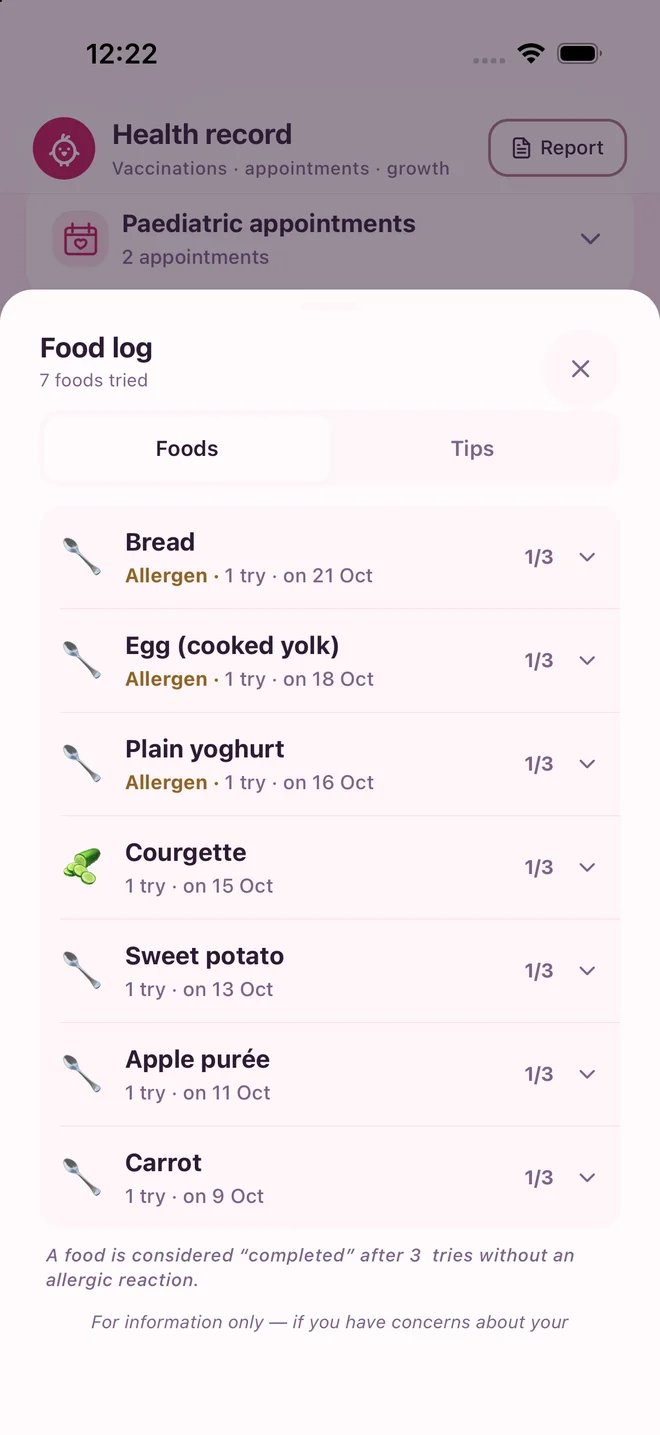
In the PetitNid app
Foods tried and 14 allergens, in one diary.
Log each new food with any reaction observed. The diary keeps foods your baby has tried and tracks the EU’s 14 food labelling allergens. This tracking list is not a recommendation to introduce every item.
Logging a meal stays free. The food and allergen diary is part of Premium.
Explore the food diary

Sources checked
Consulted when writing and reviewing this guide. French sources are identified by their original organisation names.
- AFPA (mpedia.fr) — Milk amounts by age
- Santé publique France — PNNS complementary-feeding reference chart
- AFPA (mpedia.fr) — Food and example menus from 4 to 7 months
- AFPA (mpedia.fr) — Meals from 8 to 11 months
- France’s 1000 First Days — Discovering textures from 6 to 12 months
- Santé publique France — French PNNS guide to complementary feeding
- ANSES — Nutrition guidance for children aged 0–3 (2019)
You don’t have to remember everything.
Download PetitNid to keep your baby’s meals in their journal. Meal tracking is free; the food and allergen diary is part of Premium.