
Keeping a baby food diary: paper, a table or an app
Five useful columns for a baby food diary, keeping track of allergens and symptoms, and choosing a format that works for the people sharing care.
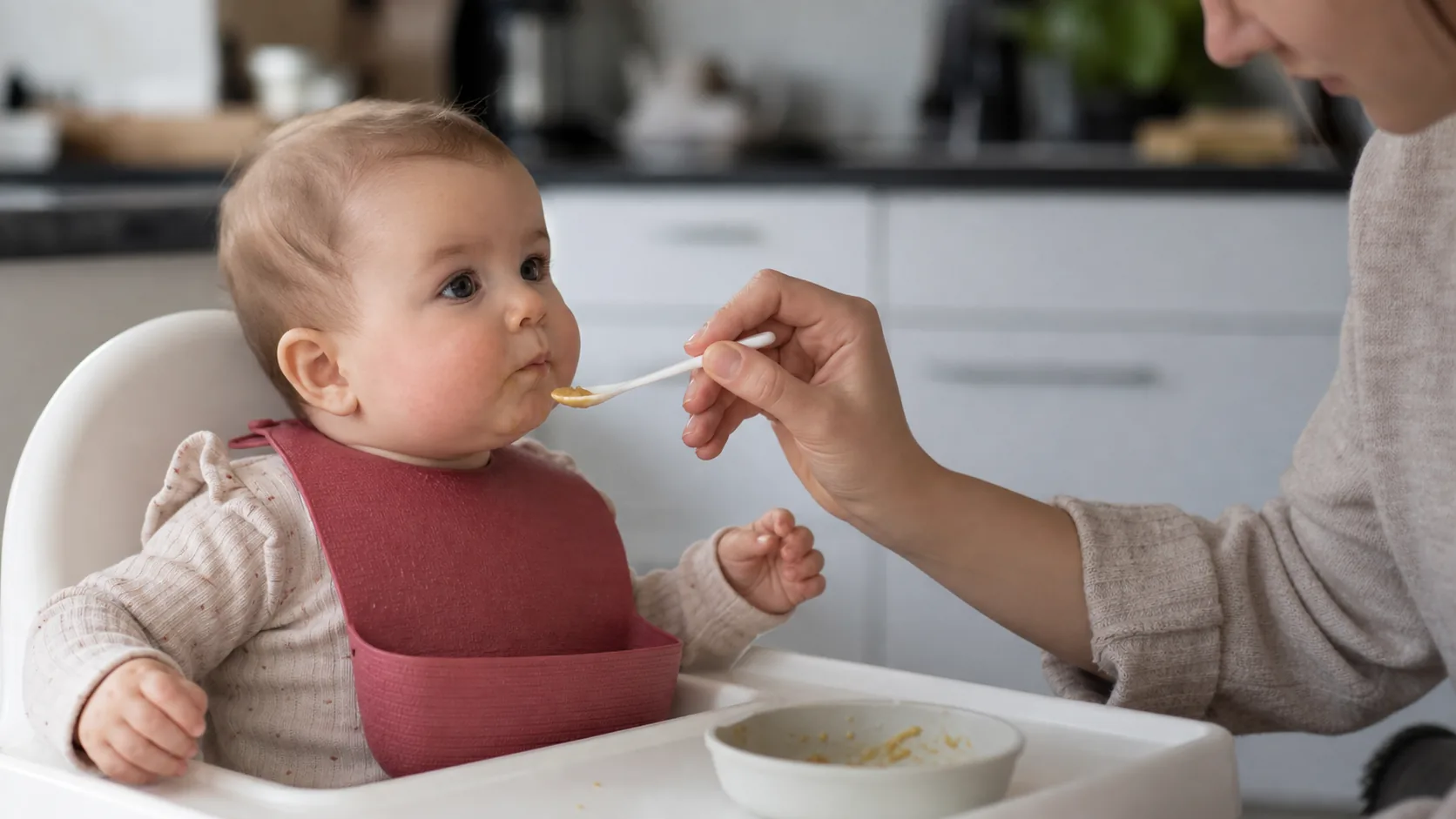
Once several foods have been tried, remembering the last offer of egg or the first taste of broccoli can be difficult. A food diary can hold those dates for you, alongside changing textures and any symptoms worth discussing.
The feeding references in this guide follow French recommendations. If you live elsewhere, check local guidance with the professional following your baby. The diary suggestions are practical options, not a medical monitoring protocol.
What a food diary can help you remember
A dated list can answer three everyday questions: what has already been offered, when a tolerated allergen was last included, and whether a food has been offered several times rather than rejected permanently after one taste.
The French 1000 First Days guidance notes that accepting a food can take repeated offers, sometimes up to ten. A record may make that pattern easier to see. It is not a reason to force a food or count attempts as a target.
A list can also be shared at an appointment or with another caregiver. Choose a format that is accessible to the people involved, and distinguish actual symptoms from simple likes and dislikes.
Five useful columns
You can start with:
- Date. Record when the food was offered.
- Food. Include the ingredients or product when relevant.
- Preparation and texture. For example, thoroughly cooked and smooth, mashed, or an age-appropriate soft texture.
- Approximate amount. A small taste or a few spoonfuls may be enough detail; mark it as approximate.
- Response. Record whether your baby tasted, accepted or refused the food, plus any symptoms and when they appeared.
If a professional requests a specific diary, follow their instructions.
A missing entry does not mean you have failed, but it makes the record incomplete. Do not use an incomplete diary as proof that a food was never eaten or that no symptoms occurred.
Keeping track of allergens
French recommendations advise introducing major food allergens without unnecessary delay once complementary feeding begins. Once tolerated, the foods continue regularly as advised. A dated record can make it easier to remember them when several caregivers share meals.
Seek medical advice before introductions if your baby has severe eczema, a known food allergy or a previous reaction. Family history can also be discussed. A record does not replace an individual allergy plan.
ANSES’s assessment reports different allergy-related measures in French studies: in the Elfe cohort, 4.0% of children at age two avoided foods on medical advice because of food allergy; Inca3 reported 4.2% declared allergies or intolerances among children aged 0–17. These are different measures and age groups. They do not predict your baby’s risk or establish that every concerning symptom is unlikely to be allergy.
See introducing food allergens for appropriate forms and warning signs. The EU’s 14 labelling categories are not a checklist of foods to introduce to a baby.
Choosing a format
| Format | Potential advantage | Practical limit |
|---|---|---|
| Paper notebook | No battery or setup; space for your own notes | Not immediately visible to someone elsewhere |
| Printed table | A clear overview in the kitchen | May need extra pages as the record grows |
| Shared spreadsheet | Searchable and sortable | May be awkward to update during a meal |
| Tracking app | Structured entries and sharing features | Needs setup; permissions and synchronisation vary |
A dated list can be easier to share than relying on memory. There is no single best format for all families. Consider who needs to see it and whether it remains easy to use when routines change.
The French PNNS brochure also gives food-storage advice: prepared purée can be kept for up to 24 hours in a sealed glass container in the refrigerator, or frozen in small portions for up to two months, labelled and identified. These are storage references from that brochure; follow hygiene conditions and individual or local guidance. Labelling the food itself matters more than remembering a date in an app.
Choosing an app for solid-food records
Our baby tracking app comparison links to publishers’ public information in a dated French-market comparison. Check current details for food records, symptom notes, sharing, privacy and account limits. A missing public detail does not necessarily mean a feature is absent.
PetitNid includes solid-food records and an EU allergen register, shared between up to two parents, with offline recording that synchronises later. It supports French and English from version 1.2.0. The register organises observations; it does not diagnose allergy or recommend introducing every listed category.
For handovers beyond solids, see sharing breast and bottle feeding records.
What may be useful at each stage
| Stage in French guidance | What a diary can record |
|---|---|
| Starting complementary foods within the 4–6-month window | Food, date, smooth texture, acceptance and any symptoms |
| Gradually changing textures | The preparation actually offered and how your baby managed it |
| Introducing individual allergens | Food, form, amount, timing and any symptoms |
| Ongoing meals | Tolerated foods offered again and questions for the next appointment |
Sources give different texture ages: PNNS allows gradual changes from around six to eight months, ANSES places non-smooth textures between eight and ten months, and AFPA describes first soft pieces around eight to nine months. These are not one interchangeable schedule. Starting solid foods explains the distinctions and supervision needs.
Keep the diary manageable
Agree on one place for information. Note things close to the meal when practical, and mark uncertainty if recording later. You can keep the record as simple as you find useful while remembering allergens already introduced.
The right detail depends on your situation and any medical instructions. A calm meal and your baby’s needs take priority over completing a box.
Never force a baby to eat for the sake of a diary entry. Refusal can be recorded and discussed if persistent.
When to ask for help
Ask the professional following your baby about persistent feeding difficulty, strong refusal of new textures, severe eczema, family allergy concerns or meals that become a repeated source of distress.
Seek prompt medical advice after suspected food-allergy symptoms such as hives, swelling or repeated vomiting, and do not reoffer the suspected food before advice.
Call emergency medical services immediately for breathing difficulty or wheezing, marked tongue or throat swelling, pronounced pallor, major weakness, collapse or loss of consciousness, or symptoms involving several parts of the body at once. In France, call 15; elsewhere, call your local emergency number. Do not delay help to finish the diary.
PetitNid is not a medical device. If you are unsure, speak to your baby’s doctor.
Frequently asked questions
What should I record in a baby food diary?
Five useful columns are date, food, texture, approximate amount and response. Record whether your baby tasted, accepted or refused the food, and any symptoms with their timing. A healthcare professional may request additional details for a specific concern.
Can a diary help with allergens?
It can help you remember which foods have been offered and continue foods already tolerated. French guidance advises introducing major allergens without unnecessary delay once complementary feeding begins. A diary does not prevent or diagnose allergy; seek medical advice first for severe eczema, known allergy or a previous reaction.
Must we leave several days between every new food?
The French PNNS chart is a guide, not a day-by-day timetable, and food groups do not have a mandatory order. If you are unsure how to pace introductions, ask the professional following your baby. Introduce new allergens individually according to the advice appropriate to your child.
Is paper or an app better?
Choose a format the people caring for your baby can access. Paper needs no device; a shared digital record can be viewed elsewhere. Check permissions and account limits rather than assuming every caregiver can access an app.
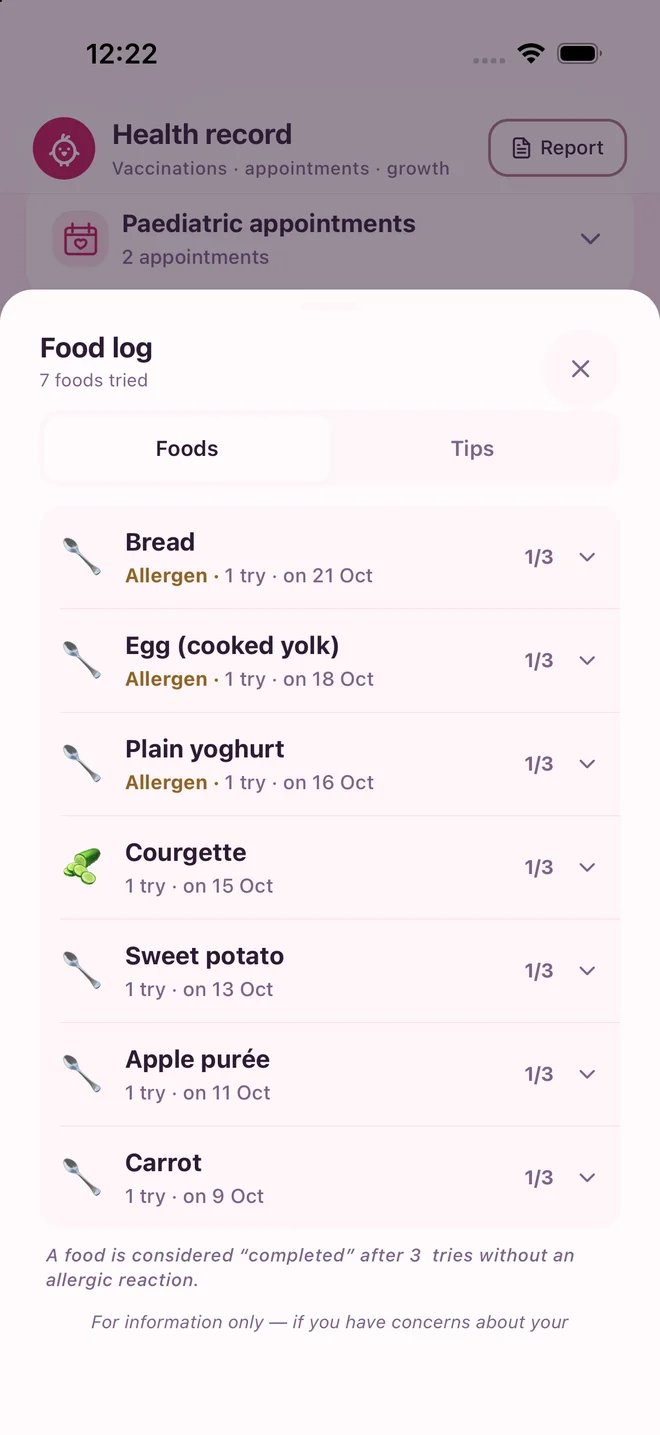
In the PetitNid app
Foods tried and 14 allergens, in one diary.
Log each new food with any reaction observed. The diary keeps foods your baby has tried and tracks the EU’s 14 food labelling allergens. This tracking list is not a recommendation to introduce every item.
Logging a meal stays free. The food and allergen diary is part of Premium.
Explore the food diary

Sources checked
Consulted when writing and reviewing this guide. French sources are identified by their original organisation names.
- AFPA (mpedia.fr) — Complementary feeding: French guidance from 4 months to 3 years
- France’s 1000 First Days — Starting solid foods between 4 and 6 months
- Santé publique France — French PNNS guide to complementary feeding
- AFPA (mpedia.fr) — Introducing food allergens: expert answer
- AFPA (mpedia.fr) — Food allergies in children
- AFPA (mpedia.fr) — Complementary feeding
- ANSES — Food allergies: ANSES assessment (2018)
- Assurance Maladie (ameli.fr) — Food allergy: symptoms and emergencies
You don’t have to remember everything.
Download PetitNid to keep your baby’s meals in their journal. Meal tracking is free; the food and allergen diary is part of Premium.