
The nine-month baby check-up in France
When France’s nine-month check-up takes place, what the doctor examines, the health certificate and the scheduled visits in the first two years.

In France, the check-up known as the nine-month visit is listed at eight completed months in the Assurance Maladie schedule, during your baby’s ninth month. Arrange the date with their doctor. It is a required check-up, covered by France’s public health insurance, and leads to the second child health certificate.
The appointment is also an opportunity to discuss everyday life. The doctor needs your observations; it is not an assessment of how well you have performed as a parent.
This guide describes the French system. If you live elsewhere, follow your local check-up schedule with your baby’s healthcare professional.
When to book it
The name can be confusing. Eight completed months means your baby has entered their ninth month. The current Assurance Maladie schedule uses that timing; do not rely on a general eight-to-ten-month window as permission to postpone it.
Contact the practice to arrange a date. If an appointment is delayed or your baby is ill, ask the doctor how to adjust the follow-up.
The visit comes before the eleven- and twelve-month vaccine appointments. See France’s 2026 vaccination schedule for that separate timetable.
Scheduled check-ups in the first two years
France provides twenty required check-ups through adolescence, including twelve in the first two years. These scheduled visits are covered by Assurance Maladie, normally without upfront payment; additional fees may fall outside this coverage.
| Age in the French schedule | Visit | Health certificate |
|---|---|---|
| Within the first 8 days | Newborn examination, often before leaving the maternity unit | First certificate |
| Second week | Follow-up examination | |
| 1, 2, 3, 4 and 5 completed months | One examination at each age | |
| 8 completed months | The visit commonly called the nine-month check-up | Second certificate |
| 11 months | Follow-up, often alongside vaccine boosters | |
| 12 months and 16–18 months | Two further check-ups | |
| 23–24 months | The two-year check-up | Third certificate |
There is no routine six-month examination in this schedule, although a vaccine dose is due then and additional appointments may be needed.
Five annual examinations are scheduled from the third through the seventh year of life, followed by examinations at eight to nine, eleven to thirteen and fifteen to sixteen years. A GP or paediatrician can provide these examinations in a practice or health centre; PMI services cover the examinations scheduled up to age five inclusive. PMI means protection maternelle et infantile, France’s maternal and child health service.
What the doctor examines
The doctor measures weight, length and head circumference, performs a physical examination, checks vision and hearing, and reviews vaccinations. Measurements are entered in the health record; understanding growth charts explains their interpretation.
AFPA emphasises vision and hearing screening at this stage. The doctor also asks about feeding, sleep, childcare and development, using what you observe at home alongside the examination.
They may observe sitting, reaching, transferring an object between hands, increasingly precise grasping and responses to sounds or the baby’s name. These are parts of a developmental assessment, not a requirement to demonstrate every skill on demand at the visit.
Development around this age
AFPA’s guidance describes broad developmental ranges. Your baby’s hand movements become more precise, and they gradually learn that an object still exists when hidden. Sitting develops during this part of infancy; individual progress and the whole examination matter more than a single isolated milestone.
AFPA describes early words or word-like sounds with gestures around nine to twelve months. Walking commonly begins between twelve and eighteen months in its guidance. Development varies, and the doctor considers overall progress when an acquisition takes longer. A later skill should not automatically be dismissed or treated as a diagnosis.
Give your baby opportunities to explore on a safe floor space and practise movements they can reach themselves, rather than placing them in standing positions. AFPA advises against baby walkers because of accident risks, including falls and burns.
Discuss concerns about development with your baby’s doctor. A clear and persistent loss of a previously acquired skill needs urgent medical assessment; French guidance calls for urgent referral to hospital paediatrics or paediatric neurology. Do not wait for the next scheduled check-up.
The health certificate and child health record
Three French examinations lead to health certificates: the examination within eight days of birth, the ninth-month visit and the twenty-fourth-month visit. The doctor completes the certificate and sends it to the departmental PMI service.
The carnet de santé stays with the family and is brought to appointments. The version introduced from 1 January 2025 includes the twenty scheduled examinations, growth and vaccination records, and information supporting identification of neurodevelopmental concerns.
It contains confidential health information. Share it appropriately with the professionals involved in your child’s care rather than treating it as an ordinary document for everyone caring for your baby.
Preparing for the appointment
- Note questions in advance, including feeding, sleep, vision, hearing or development concerns.
- Bring the child health record, your French health-insurance card where applicable, and any recent reports.
- Bring changing supplies and a familiar toy. Plan feeding around your baby’s needs rather than withholding a feed for the appointment.
- Speak calmly to your baby and tell the professional what usually reassures them.
No routine vaccine is scheduled at this visit in the usual French infant course, although catch-up or individual circumstances can change that. The vaccination guide describes appointment preparation and aftercare.
For sleep questions, sleep patterns by age can help you describe what you have noticed without replacing the assessment.
If the appointment has been missed
Contact the doctor to arrange it and review the remaining schedule. Bring the existing record if you have changed practice, so previous checks and vaccines can be verified.
Complementary feeding is another useful topic at this age. Starting solid foods can help you prepare questions about textures, intake or allergens, while the professional adapts advice to your baby.
PetitNid is not a medical device. If you are unsure, speak to your baby’s doctor.
Frequently asked questions
When is the nine-month visit in France?
Assurance Maladie lists this check-up at eight completed months, during the baby’s ninth month. Arrange the date with your baby’s doctor.
What does the doctor check?
The doctor measures weight, length and head circumference, examines the baby, checks vision and hearing, and observes development. They also ask about feeding, sleep, childcare and your concerns. Development is considered as a whole, not as a checklist every baby must complete on one day.
Is the visit required and covered in France?
Yes. It is one of France’s required child health check-ups and is covered by Assurance Maladie, without an upfront payment. A GP or paediatrician can perform it, including in a health centre or PMI service. The doctor must charge the standard statutory fee for this certificate examination, with no extra fee.
What happens to the health certificate?
The doctor completes the second health certificate after the examination and sends it to the departmental PMI service, France’s maternal and child health service. Bring the child health record to keep the follow-up information together.
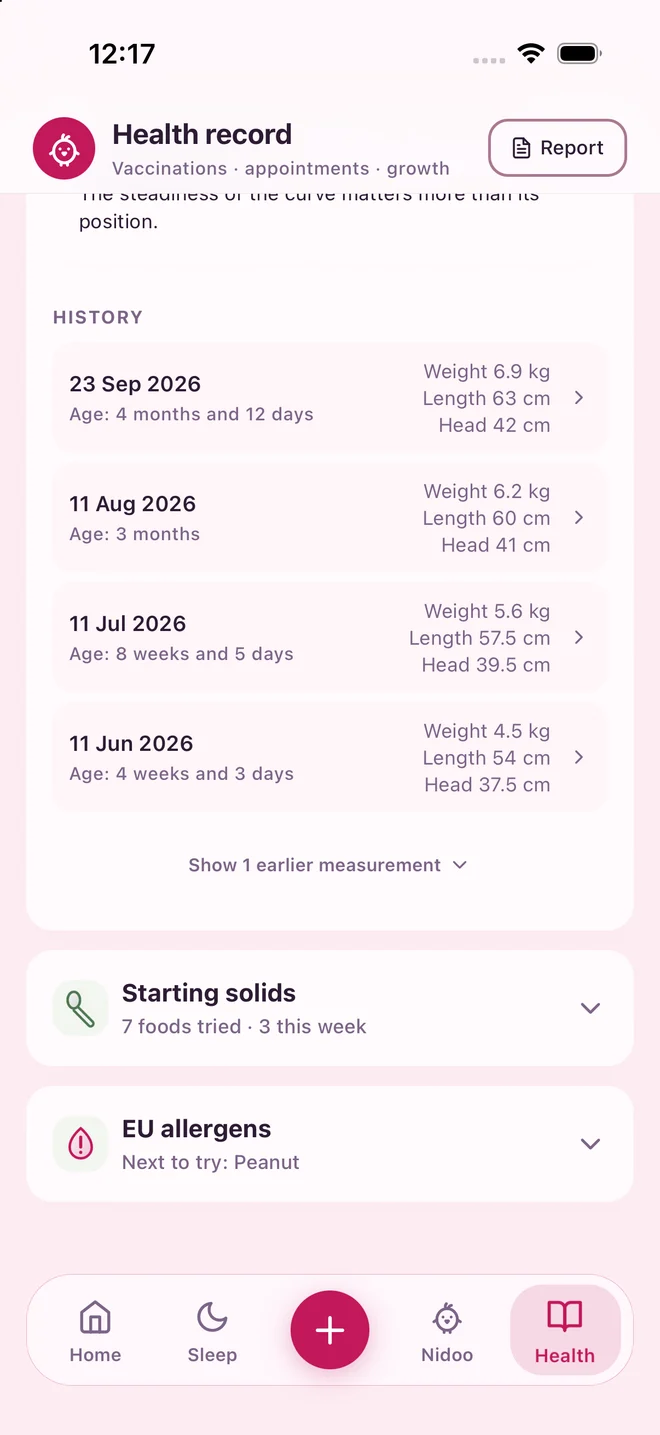
In the PetitNid app
Vaccinations, visits and growth charts, in one place.
The record brings together vaccinations, visits and measurements plotted on WHO charts. You can create a PDF report before an appointment.
The full health record is part of Premium. It does not replace the official health record.
Explore the health record

Sources checked
Consulted when writing and reviewing this guide. French sources are identified by their original organisation names.
- Assurance Maladie — Identifying unusual development in children under seven
- Assurance Maladie (ameli.fr) — 20 scheduled health check-ups in France
- Assurance Maladie (ameli.fr) — Scheduled child health check-ups in France
- AFPA (mpedia.fr) — Health check-ups from 6 to 12 months
- AFPA (mpedia.fr) — Using the French child health record
- AFPA (mpedia.fr) — Development from 9 to 12 months
- Vaccination Info Service — Preparing for vaccination
- AFPA (mpedia.fr) — Development from 6 to 9 months
You don’t have to remember everything.
Download PetitNid to keep track of your baby’s day. Essential tracking is free; vaccinations, growth charts and PDF reports are part of Premium.