
France’s 2026 vaccination schedule for babies
France’s 2026 baby vaccination schedule from two to eighteen months, with required and recommended vaccines, appointments and aftercare guidance.

In France, routine infant vaccination starts at two months, with further doses at three, four, five and six months, then eleven, twelve and sixteen to eighteen months. Combination vaccines protect against several diseases in one injection.
This is France’s 2026 schedule. If you live elsewhere, use your local vaccination schedule with the professional following your baby. Individual circumstances, previous doses, prematurity and medical conditions can change the plan.
The routine French schedule by age
This table describes the usual course for a baby born in 2026, based on Vaccination Info Service. It is not a prescription for an individual child.
| Age | Vaccines in the routine schedule |
|---|---|
| 2 months | Hexavalent: first dose against diphtheria, tetanus, polio, pertussis, Hib and hepatitis B; pneumococcal: first dose; oral rotavirus: first dose if chosen |
| 3 months | Meningococcal B: first dose; oral rotavirus: second dose |
| 4 months | Hexavalent and pneumococcal: second doses; oral rotavirus: third dose for the three-dose product |
| 5 months | Meningococcal B: second dose |
| 6 months | Meningococcal ACWY: first dose |
| 11 months | Hexavalent: third dose; pneumococcal booster |
| 12 months | Measles, mumps and rubella (MMR): first dose; meningococcal B and ACWY boosters |
| 16–18 months | MMR: second dose |
Your doctor schedules the appointments and checks which products and doses are appropriate. For babies born prematurely, AFPA describes an additional pneumococcal primary dose, giving doses at two, three and four months before the booster. The doctor adapts the course.
Before two months: RSV protection and BCG
Respiratory syncytial virus, or RSV, is the main cause of bronchiolitis. French prevention guidance describes two approaches: vaccination of the pregnant parent between 32 and 36 weeks of pregnancy, or a single injection of antibodies for the baby, ideally before leaving the maternity unit when appropriate.
The antibodies given to a baby are not a baby vaccine. They may also be indicated despite vaccination during pregnancy, including in prematurity or birth less than fourteen days after that vaccination. Discuss eligibility with the maternity team.
In mainland France, the 2026–2027 campaign runs from 14 September 2026 to 28 February 2027. A baby born outside the campaign may be eligible for antibodies during their first season of RSV circulation. The professional determines the applicable timing.
BCG, against tuberculosis, is offered from around one month to babies at increased risk, with individual exceptions. Risk factors may include family origins in a high-incidence country or living in French Guiana or Mayotte. It is not a routine recommendation for every baby worldwide.
Meningococcal changes in 2026
Meningococcal infections can cause serious disease, including meningitis and bloodstream infection. ACWY and B vaccination became required for infants in France from 1 January 2025. The 2026 schedule extends the requirement to children born from 1 January 2023.
For a baby born in 2026:
- ACWY replaces the earlier meningococcal-C-only schedule, with doses at six and twelve months.
- Meningococcal B is given at three and five months, with a booster at twelve months.
A temporary catch-up programme covers ages two to four completed years, up to the fifth birthday, including children previously vaccinated against meningococcal C. The doctor checks what remains due for an older sibling rather than simply repeating the infant course.
Required and recommended vaccines
The French infant requirements cover diphtheria, tetanus, polio, pertussis, Hib, hepatitis B, pneumococcal disease, measles, mumps, rubella and meningococcal groups A, B, C, W and Y. These requirements relate to entry into settings such as childcare and school in France.
Rotavirus vaccination is recommended rather than required. It is given orally in two or three doses, depending on the product. Vaccination Info Service describes an early start, with the first dose no later than four months and completion before six or eight months depending on the vaccine. Ask early so the professional can check the exact product limits.
Early vaccination is intended to protect during an age when these infections can be particularly serious and protection from antibodies transferred during pregnancy is declining.
Where vaccination takes place in France
Options include your GP or paediatrician, a midwife, a nurse working under the applicable prescription arrangements, a PMI service for children under six, or a public vaccination centre. PMI means protection maternelle et infantile, France’s maternal and child health service.
In France, reimbursement depends on the vaccine and setting. Vaccination is free in PMI services and public vaccination centres. Check current details with Assurance Maladie, the French public health insurance service.
Many vaccine ages coincide with scheduled health check-ups covered by Assurance Maladie. The six-month ACWY dose falls outside the usual check-up calendar, so it is useful to note separately.
At the appointment
The professional checks your baby’s health and previous doses. A mild cold does not usually prevent vaccination, while illness with fever may lead them to postpone it.
Several vaccines may be given at one appointment at separate sites, commonly the thigh in a baby who is not yet walking. The approved combinations and timing are chosen by the professional.
If you breastfeed, you can feed your baby during the injection. The vaccinating professional can also suggest ways to reduce discomfort. Holding and talking gently to your baby may help; tell the professional what usually reassures them.
Ask whether paracetamol is appropriate for your baby. The professional may recommend it for fever or discomfort with some vaccines, including meningococcal B. Follow the professional’s instructions for any medicine.
Stay for the period of observation advised after vaccination, because immediate allergic reactions, although rare, need prompt care.
Measures from a combined check-up are entered on growth charts. The nine-month check-up has no routine vaccine in this schedule, although catch-up may be needed.
After vaccination
Common reactions described by Vaccination Info Service include local redness, soreness or swelling, fever, reduced appetite, sleepiness or irritability. Those common reactions often settle within two days; this does not mean every possible reaction occurs or ends within that period.
Offer comfort and observe your baby’s condition. Ask the professional how to manage discomfort or fever and follow their instructions for any medicine.
If your baby is under three months and has a fever, seek urgent medical assessment, even after vaccination.
After a rotavirus vaccine, seek prompt medical assessment for unusual crying, episodes of pallor, vomiting, refusal to feed or drink, or blood in the stool. These signs need attention rather than being dismissed as routine after-effects.
Contact a doctor promptly about high fever, a rash, persistent inconsolable crying or an injection site that becomes increasingly inflamed. Seek urgent medical assessment if your baby becomes unusually drowsy or floppy, refuses fluids or their general condition deteriorates. For difficulty breathing or facial, tongue or throat swelling, call emergency medical services immediately: 15 in France or your local emergency number elsewhere.
You can also read our guide to sleep patterns by age, without assuming sleep changes have a particular cause.
If a dose is late
Most vaccination courses continue from the missing dose rather than restarting. Contact the professional to arrange catch-up promptly. Rotavirus is an important exception to a simple “give it later” approach because of its product-specific age limits.
Bring your baby’s health record so the professional can verify previous doses. These months also overlap with starting complementary foods, another topic you can discuss at appointments.
PetitNid is not a medical device. If you are unsure, speak to your baby’s doctor.
Frequently asked questions
Which baby vaccines are required in France in 2026?
The French requirements cover diphtheria, tetanus, polio, pertussis, Hib, hepatitis B, pneumococcal disease, measles, mumps, rubella and meningococcal groups A, B, C, W and Y. The meningococcal requirement applies to children born from 1 January 2023. Rotavirus vaccination is recommended but not required.
When do routine infant vaccines start in France?
For most babies the routine schedule starts at two months with the hexavalent and pneumococcal vaccines; oral rotavirus vaccination can also begin then. Earlier RSV protection may involve vaccination during pregnancy or antibodies given to the baby after birth, depending on eligibility.
What changes in the 2026 French schedule?
The meningococcal ACWY and B requirement is extended to children born from 1 January 2023. A temporary catch-up programme covers children aged two to four completed years, including those previously vaccinated against meningococcal C. The routine schedule for babies born in 2026 remains ACWY at six and twelve months and B at three, five and twelve months.
What if an appointment is delayed?
Ask the vaccinating professional to adjust the schedule. Most courses continue with the missing doses rather than restarting. Rotavirus has strict product-dependent age limits, so a delay needs particular attention. A mild cold does not usually prevent vaccination; the professional assesses illness or fever.
In the PetitNid app
Vaccinations, visits and growth charts, in one place.
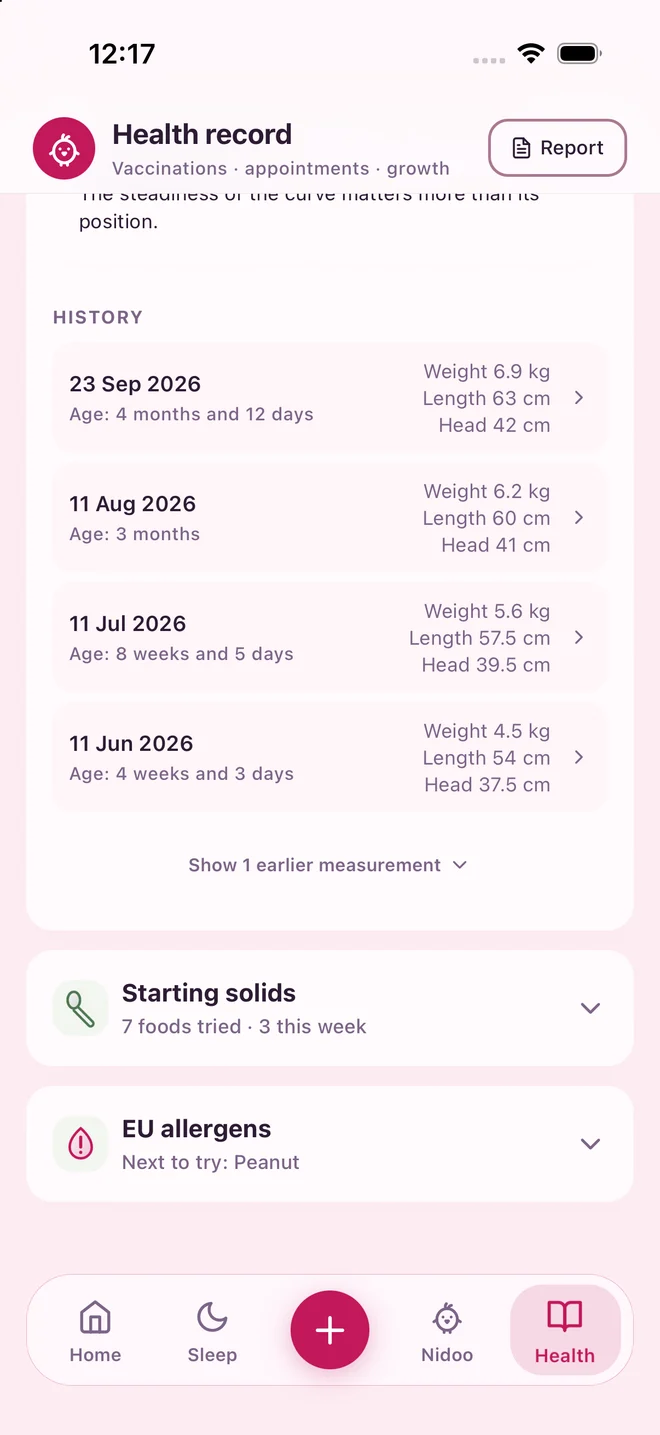
The record brings together vaccinations, visits and measurements plotted on WHO charts. You can create a PDF report before an appointment.
The full health record is part of Premium. It does not replace the official health record.
Explore the health record

Sources checked
Consulted when writing and reviewing this guide. French sources are identified by their original organisation names.
- Vaccination Info Service — Vaccination for babies and children in France
- AFPA (mpedia.fr) — Vaccination schedule from birth to 11 years
- Vaccination Info Service — Invasive meningococcal infections
- Vaccination Info Service — Rotavirus gastroenteritis
- Assurance Maladie (ameli.fr) — Preventing bronchiolitis
- Vaccination Info Service — Why vaccinate soon after birth?
- Assurance Maladie (ameli.fr) — Vaccination coverage in France
- Assurance Maladie (ameli.fr) — 20 scheduled health check-ups in France
- Assurance Maladie (ameli.fr) — Baby health check-ups from 3 to 18 months
- Vaccination Info Service — Preparing for vaccination
- Vaccination Info Service — After vaccination
- Assurance Maladie (ameli.fr) — Medicines for fever in children
- Assurance Maladie (ameli.fr) — Fever in children: when to seek medical help
- Assurance Maladie (ameli.fr) — Food allergy: symptoms and emergencies
You don’t have to remember everything.
Download PetitNid to keep track of your baby’s day. Essential tracking is free; vaccinations, growth charts and PDF reports are part of Premium.